

Batteries have become a practical part of maritime decarbonization. They are used on ferries, harbor craft, tugs, offshore support vessels, crew transfer vessels, various types of remotely operated vessels, and hybrid ships to reduce fuel burn, provide spinning reserve, support dynamic positioning, enable peak shaving, and allow zero-emission operation in port.

China and Denmark renewed a memorandum of understanding on cooperation in green maritime technology and shipbuilding during a meeting between the two nations' industry ministers in Beijing on Tuesday, China's industry ministry said in a statement.China is willing to jointly conduct research and development with Denmark on low-carbon and zero-carbon fuel-powered ship technologies and explore
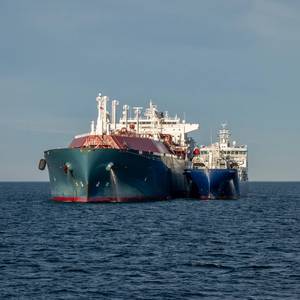
A sanctioned liquefied natural gas (LNG) tanker made a ship-to-ship (STS) transfer off the coast of Malaysia after picking up a cargo from a Russian export terminal also under Western restrictions, according to two analytics firms.The operation appears to be the first known STS transfer of sanctioned Russian LNG, despite Western efforts to curb Moscow's energy revenues over its war in Ukraine.
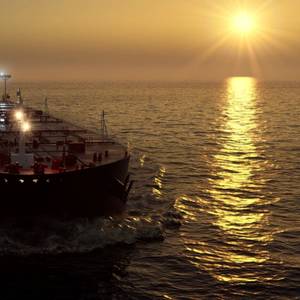
Britain targeted Russia's two largest oil companies, Lukoil and Rosneft, and 44 shadow fleet tankers on Wednesday in what it described as a new bid to tighten energy sanctions and choke off Kremlin revenues.Lukoil and Rosneft were designated under Britain's Russia sanctions laws for what London described as their role in supporting the Russian government.

Ship-to-ship transfers in the Gulf of Oman for Middle Eastern oil from inside the Strait of Hormuz have reached their limits after Saudi Arabia diverted exports from the Red Sea, adding to shipments from other producers, trade sources and analysts said.The increasing amount of Saudi exports this month requires more supertankers to shuttle crude through Hormuz to conduct cargo transfers, they said.

Oil prices fell for a third consecutive day on Thursday as concerns over supply disruptions eased after Qatar said Iran and the U.S. had made progress in talks over the Strait of Hormuz.Brent futures LCOc1 were 66 cents or 0.92% lower at $70.91 a barrel at 0758 GMT, while U.S. West Texas Intermediate crude CLc1 fell 59 cents or 0.86% to $67.99 a barrel, their lowest level since February 27.

Oil prices edged down after Oman said operations at Mina al Fahal port were proceeding normally, following a Reuters report that oil loadings had been suspended after an explosion.Brent crude futures LCOc1 fell 24 cents, or 0.25%, to $94.79 a barrel by 0704 GMT after settling down 2.84% in the previous session.U.S. West Texas Intermediate crude CLc1 was at $92.48 a barrel, down 56 cents, or 0.

Oil prices jumped more than 2% on Thursday after Iran's Revolutionary Guards said they targeted a U.S. airbase in response to a U.S. attack in the port city of Bandar Abbas.Brent crude futures LCOc1 rose $2.34, or 2.48%, to $96.63 a barrel by 0701 GMT, while the more active August contract LCOc2 gained $2.24 or 2.43%, to $94.49. The July contract is set to expire on Friday.U.S.

Oil prices edged higher on Thursday, as investors monitored peace talks between the United States and Iran, while supply tightness and U.S. inventory drawdowns provided some support.Brent crude futures LCOc1 rose 40 cents, or 0.4%, to $105.42 a barrel by 0809 GMT, and U.S. West Texas Intermediate futures CLc1 were up 50 cents, or 0.5%, at $98.76.Both benchmarks dropped around 5.

Oil prices edged up on Thursday, with markets focusing on the high-stakes meeting between U.S. President Donald Trump and Chinese President Xi Jinping to see if it will yield any positive results towards a resolution for the Iran war.Trump is expected to encourage China to convince Tehran to make a deal with Washington to end the conflict

China conducted military drills recently including live-fire exercises in waters east of the Philippines' Luzon Island, it said on Friday, as Manila and Washington host annual drills that extend towards disputed areas of the South China Sea.Over 17,000 troops from the U.S., the Philippines and allies began their annual Balikatan military exercises this week

CK Hutchison posted a 7% rise in 2025 underlying profit on Thursday, as the market awaits updates on the company's proposed sale of its ports business and other spin-off plans.The Hong Kong ports-to-telecoms conglomerate reported underlying profit of HK$22.3 billion ($2.85 billion) on a post-IFRS 16 basis. That compared with an HK$22.9 billion LSEG SmartEstimate and the HK$20.