

Eleven sailors were missing at sea on Tuesday from a ship sunk by a drone attack off the coast of Bulgaria, possibly the second deadly sinking of a cargo vessel in the area in a week, prompting Bulgaria to summon Russia's ambassador.Two cargo ships were hit by drones overnight and one was sunk, Bulgarian officials said.

British commandos boarded and intercepted a sanctioned Russian shadow fleet oil tanker in the Channel on Sunday, leading for the first time an operation to disrupt the oil revenue that helps fund Russia's war in Ukraine.The vessel Smyrtos, sailing under a Cameroonian flag, was boarded by Royal Marine Commandos and National Crime Agency (NCA) officials in the early hours on Sunday

The U.S. Coast Guard commissioned its newest Fast Response Cutter, USCGC Vincent Danz (WPC 1162), for official entry into its service fleet during a ceremony held in New York City on Friday.The Vice Commandant of the Coast Guard, Vice Adm. Thomas Allan, presided over the ceremony. Members of the Danz family were also in attendance, including the cutter's sponsor, Angela Donohue

U.S. President Donald Trump's move allowing foreign-flagged cargo ships to move fuel and other goods between domestic ports has so far had little impact on American oil supply, according to trade data and analysts who noted that U.S. refiners and shippers are earning more profits sending fuel overseas.

Explosive-laden Iranian boats appear to have attacked two fuel tankers in Iraqi waters, setting them ablaze and killing one crew member on Wednesday, after projectiles struck four vessels in Gulf waters, said port, maritime security and risk firms.The latest attacks on ships linked to the U.S. and Europe mark an escalation in the conflict between Iran and U.S.

The United States on Friday threatened to use visa restrictions and sanctions to retaliate against nations that vote in favor of a plan put forward by a United Nations agency to reduce planet-warming greenhouse gas emissions from ocean shipping.U.N. member nations are scheduled to vote next week on the International Maritime Organization's Net-Zero Framework proposal to reduce global carbon

Zelim announced that it is has established a site in Atlantic Canada, marking its commitment to strategic expansion in the North American maritime market. The site will be located at the COVE ocean facility in Dartmouth, Nova Scotia, a major technology hub for maritime innovation.Starting in April 2026

The Chicago Propeller Club has announced its first event of 2026, featuring author John U. Bacon discussing his book The Gales of November and the enduring story of the SS Edmund Fitzgerald.The event will take place on April 14 at the Guinness Open Gate Brewery in Chicago’s West Loop and will include a live conversation between Bacon and Tom Wiater, President of Central Marine Logistics.

British energy major BP has received approval from the Trump administration to advance its Kaskida project in the Gulf of Mexico, a company spokesperson told Reuters in an emailed statement late on Friday.The $5 billion investment would unlock 10 billion barrels of resources that BP has discovered in the Paleogene fields of the U.S. Gulf, the spokesperson said.The U.S.

The Tennessee-Tombigbee Waterway Development Authority has elected Governor Tate Reeves of Mississippi to serve as Chairman for 2026. Governor Reeves will lead the four-state interstate compact as it advances economic development, freight mobility, and recreation along the Tennessee-Tombigbee Waterway and the broader M-65 Marine Highway corridor.
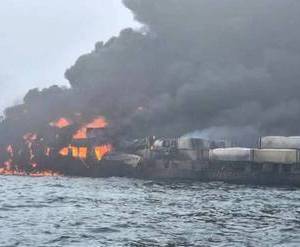
The captain of a container ship that crashed into a U.S. tanker off Britain's east coast last year was jailed for six years on Thursday for causing the death of a crew member through gross negligence.Russian national Vladimir Motin, 59, was captain of the Portuguese-flagged Solong when it hit the Stena Immaculate tanker, which was anchored and carrying just over 220

Britain imposed sanctions on Thursday on more Russian oil companies and Canadian-Pakistani billionaire Murtaza Lakhani as part of efforts to ramp up pressure on Moscow over the war in Ukraine.The government targeted 24 individuals and entities, including what it described as Russia's largest remaining unsanctioned oil companies: Tatneft, Russneft, NNK-Oil and Rusneftegaz.