

Eleven sailors were missing at sea on Tuesday from a ship sunk by a drone attack off the coast of Bulgaria, possibly the second deadly sinking of a cargo vessel in the area in a week, prompting Bulgaria to summon Russia's ambassador.Two cargo ships were hit by drones overnight and one was sunk, Bulgarian officials said.

Four shipowners from Sweden, Norway and Canada have ordered four new VINGA product tankers for delivery in 2028 and 2029, expanding the Furetank-developed vessel series to 26 ships.Two of the vessels will be owned by FureBear, a joint venture between Sweden's Furetank and Canada's Algoma Central Corporation, while Norway's O.H. Meling and Sweden's Älvtank will each take one.The order marks O.H.

Since the Iranian Revolution and overthrow of Shah Mohammad Reza Pahlavi in 1979, the Strait of Hormuz has been a geographic constant as a choke point for which closure has been threatened from time to time but never truly closed. The longstanding assumption of the continued openness of the strait collapsed on February 28, 2026.

Bulgaria expects to join a NATO anti-drone initiative by the end of October, Defence Minister Dimitar Stoyanov said on Wednesday, a day after a drone attack sank a cargo vessel off the country's Black Sea coast for the second time in a week.The attacks have highlighted the growing threat that drone warfare linked to the Russia-Ukraine war poses to commercial shipping near NATO's southeastern

Sanmar Shipyards has delivered NICO, a powerful and versatile new tug designed for both harbour ship-handling and towing operations, to German operator H. Schramm Towage.The latest delivery is the seventh SANMAR-built tug to join the H. Schramm Towage fleet, continuing a relationship between the two companies that dates back to 2005.

C&C Marine and Repair has delivered the M/V Mimsy H. Lindner to Canal Barge Company, completing a four-boat series of 2,600-horsepower inland towboats for the New Orleans-based operator. The Mimsy H. Lindner follows the M/V Al Sloss, M/V Deborah H. Valentine and M/V Cabby H. Boone, all built by C&C's Belle Chasse shipyard since January.The M/V Mimsy H.

Maritime Tactical Systems, Inc. (MARTAC), a U.S.-based, leading provider of fully autonomous unmanned surface vessels (USVs), announced the strongest first-half results in the company’s 15-year history.MARTAC concluded record results for the six months ending June 30, 2026 across orders, funded backlog, revenue, profitability and cash flow.

Nippon Paint Marine, a marine coatings leader, has supplied its self-indicating epoxy coating NOA 60 HS, to protect two new floating dry docks for Grand Bahama Shipyard. The floating docks have a combined total of around 1.2 million square meters of surface to be protected. This equates to the area of over 168 full size FIFA football pitches.

Frontline plc (NYSE and OSE: FRO) entered into one-year time charter-out agreements for seven of its VLCCs. The charters will commence during the period from late-January to April 2026 at a rate of $76,900 per day per vessel.“We are in unprecedented times, and these are charter-out-levels not seen for decades," said Lars H. Barstad, CEO, Frontline Management AS.

HII’s Ingalls Shipbuilding division has delivered Arleigh Burke-class guided missile destroyer Ted Stevens (DDG 128) to the U.S. Navy. This marks the second Flight III Arleigh Burke-class destroyer to be delivered by Ingalls shipbuilders.“The delivery of Ted Stevens reflects the strong momentum of our destroyer program as we accelerate Flight III production and bring enhanced capabilities to the
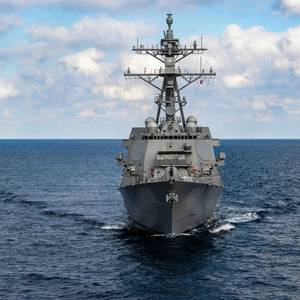
HII’s Ingalls Shipbuilding division successfully completed the final round of sea trials for Arleigh Burke-class guided missile destroyer Ted Stevens (DDG 128). The Ingalls Test and Trials team spent several days in port and at sea conducting a comprehensive series of acceptance test and evaluations, overseen by the Navy’s Board of Inspection and Survey (INSURV).
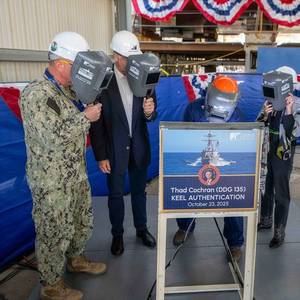
HII’s Ingalls Shipbuilding authenticated the keel today of Arleigh Burke-class guided missile destroyer Thad Cochran (DDG 135). The ship honors Thad Cochran, a Navy veteran and former U.S. senator who represented Mississippi from 1978 to 2018. Ceremony attendees included Cochran’s wife and ship sponsor Kay Webber Bowen Cochran and Ingalls shipbuilders.