

When artificial intelligence (AI) and digitalization are discussed in maritime, attention still gravitates toward autonomous ships. Yet the market is not about de-crewing but, rather, applying vessel and shore data to make operations safer, more fuel-efficient, and easier to maintain.As of 2024, the maritime AI market stood at $4.13 billion, with a projected five-year CAGR of 23%.

Accelerating demand for subsea power and telecoms cable network construction is fuelling major expansion of the world fleet of purpose-designed cable laying, maintenance and repair vessels.Driven by the growth of the offshore renewables sector and its advance into deeper waters, as well as by widening investment in cables connecting electrical grids in different countries

The U.S. is expanding its icebreaking fleet to strengthen Arctic and domestic access, and support commercial shipping, seabed resources, subsea cables and fisheries. Current plans include 1–3 heavy Polar Security Cutters (PSCs), 11 medium Arctic Security Cutters (ASCs), seven Homeland Security Cutter (HSC) HSC-L (light) icebreakers, 11 HSC-Ms (medium) and one additional heavy HSC-H (heavy).

A wave of new investment in dedicated shuttle tankers has been spurred by the age profile of the existing fleet coupled with surging developments in the Brazilian offshore market.Constituting a specialized asset class, dynamic positioning (DP) shuttle tankers are a flexible and cost effective way of lifting and transporting oil from offshore fields

A bipartisan group of U.S. senators on Monday urged President Donald Trump to hold fast to trade remedies proposed by his administration to rebuild U.S. shipbuilding and not offer concessions when he meets with Chinese President Xi Jinping.Democratic Senators Tammy Baldwin of Wisconsin and Mark Kelly of Arizona as well as Republicans Tim Scott of South Carolina and Todd Young of Indiana told
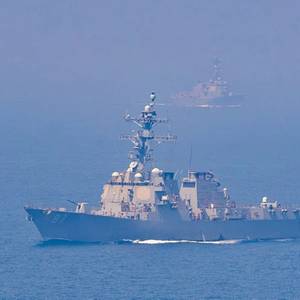
The U.S. military said it carried out retaliatory strikes on Iran on Thursday, targeting sites it said were responsible for attacking U.S. forces in what it called unprovoked hostilities by Tehran.Earlier, Iran's top joint military command said the U.S. had violated a ceasefire by targeting an Iranian oil tanker and another ship entering the Strait of Hormuz, and by striking civilian areas."U.S.

Continuous design refinement and incremental productivity gains — reflecting the Japanese concept of kaizen — alongside unremitting attention to contractual performance and product quality have seen the country’s shipbuilders maintain a high profile in certain sectors of the commercial vessel market.

Shippers on Wednesday said they needed more clarity on the terms of the U.S.-Iran ceasefire before resuming transit through the Strait of Hormuz, as Iran said the waterway remained closed to vessels sailing without a permit.The six‑week conflict had brought traffic through the strait - a chokepoint for about 20% of global oil and liquefied natural gas (LNG) shipments - close to a standstill

China and Russia on Tuesday vetoed a U.N. resolution encouraging states to coordinate efforts to protect commercial shipping in the Strait of Hormuz, calling the measure biased against Iran, while Washington's ambassador to the world body called on "responsible nations" to join the U.S. in securing the waterway.

U.S. President Donald Trump's move allowing foreign-flagged cargo ships to move fuel and other goods between domestic ports has so far had little impact on American oil supply, according to trade data and analysts who noted that U.S. refiners and shippers are earning more profits sending fuel overseas.

Malaysia's Prime Minister Anwar Ibrahim said on Thursday he had spoken to the leaders of Iran, Egypt, Turkey and other regional countries and said Malaysian vessels were now being allowed to pass through the Strait of Hormuz.Anwar in a televised address thanked Iran's president for allowing the passage of Malaysian ships.

The FPSO P-78 can produce up to 180,000 barrels per day and will increase the gas supply.Petrobras began oil production from the P-78 floating production, storage and offloading (FPSO) vessel in the Búzios field, in the pre-salt layer of the Santos Basin, this Wednesday, December 31, 2025. Búzios 6 (P-78) has the capacity to produce 180,000 barrels of oil and 7.2 million m³ of gas per day.