

Ongoing fleet renewal by niche player Cool Carriers indicates continuing competitiveness at scale of the specialized, pallet-optimized reefership.Not so long ago, it seemed that the unrelenting march of containerization and ever-widening influence of the powerful ocean container line entities would finally usurp the conventional, breakbulk refrigerated cargo vessel.

Two supertankers and one liquefied natural gas (LNG) tanker exited the Strait of Hormuz earlier this week with their transponders switched off, and are heading for India and China, shipping data from LSEG and Kpler showed.The vessels joined a number of tankers leaving the Gulf this month, although oil and LNG traffic overall has still been limited.

Introduction. Looking back at history one could argue that it was French author Jules Verne in his book “20,000 Leagues Under the Sea”, published in 1869, who was speculating about a new power source much in the same out of the box thinking that H.G. Wells employed when he wrote about inter-planetary flight in “War of the World’s.

Many claim to have ‘saltwater in their veins,’ but all you have to do is walk into the corner office of John McDonald, the new Chairman and CEO of the American Bureau of Shipping (ABS), to see that him saying “I was born into maritime” is not hyperbole. The first thing that greets you is a Dusan Kadlec nighttime painting of the Brooklyn Bridge

Subsea7 has agreed to sell its Seaway7 heavy transportation business, comprising six semi-submersible vessels, to HEA Energy in a transaction linked to its proposed merger with Saipem.The sale covers six open-deck semi-submersible heavy transportation vessels, five of which are owned and one chartered from a third party.

ABS has launched Eagle CRoute, an online tool designed to help containership operators improve operational flexibility through route-based lashing reduction factor calculations.Changing port rotations, blank sailings, evolving stowage plans and shifting geopolitical conditions are increasing pressure on operators to make faster loading decisions.

Oil prices fell more than 1% on Tuesday, extending losses from the previous session, on signs of some progress in restoring crude flows through the Strait of Hormuz following U.S.-Iran peace talks.Brent crude futures LCOc1 fell $1.09, or 1.4%, to $76.81 a barrel and U.S. West Texas Intermediate CLc1 declined to $72.99 a barrel, down 87 cents, or 1.2%, as of 0607 GMT.

Crosby Enterprises, LLC (the “Company”) announced that the Company filed chapter 11 cases for several of its subsidiary/affiliate units, Crosby Tugs, L.L.C., Crosby Dredging, L.L.C. and Crosby Marine Transportation, L.L.C., in the U.S. Bankruptcy Court for the Eastern District of Louisiana on March 23, 2026.

The American Club has reported positive developments for the 2026 renewal across all lines of business. Gross tonnage for the Club’s Class I (mutual P&I) entries increased modestly at the turn of the renewal at Noon GMT 20 February 2026, while the tonnage position since the 2025 renewal has increased by 5% and over the same period, Class I premiums have grown by 6%.
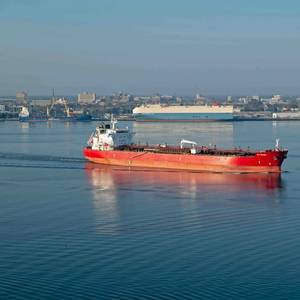
U.S. diesel exports to Europe hit an all‑time high in January after the continent strengthened its ban on imports of Russian-derived fuel, and as discounted Russian diesel displaced U.S. fuel in Brazil, data showed and analysts said.The developments show how Western sanctions, aimed at punishing Russia over its invasion of Ukraine, are reshaping markets, allowing U.S.

Finnish police on Wednesday seized a ship sailing from Russia on suspicion of sabotaging an undersea telecoms cable running from Helsinki to Estonia across the Gulf of Finland, an area hit by a string of similar incidents in recent years.The seized cargo vessel "Fitburg" was en route from the Russian port of St Petersburg to Israel at the time of the incident

Clippership, a company developing autonomous wind powered ships, announced it has completed the design of its first 24-meter class vessel, and executed a construction contract for the first cargo vessel with Dutch shipyard KM Yachtbuilders.The 24-meter class features twin, foldable rigid wings for primary wind propulsion and is designed for open-ocean autonomy.