

The American Great Lakes Ports Association has signed a Memorandum of Understanding (MoU) with the Great Lakes Alliance of Shipyards to advance shared priorities in domestic shipbuilding and commerce.The MoU marks the first formal partnership between the U.S. Great Lakes port and shipyard communities.

For decades, floating nuclear power occupied a niche position in the energy debate – technically feasible, strategically intriguing, but commercially marginal. Today, however, combined pressures of decarbonization, energy security, land constraints, rising electricity demand and water scarcity are making floating nuclear power a more serious proposition for policymakers, utilities

Introduction. Looking back at history one could argue that it was French author Jules Verne in his book “20,000 Leagues Under the Sea”, published in 1869, who was speculating about a new power source much in the same out of the box thinking that H.G. Wells employed when he wrote about inter-planetary flight in “War of the World’s.

The U.S. Supreme Court is set to explore legal questions arising from the fraught history of U.S.-Cuban relations when it considers the scope of a 1996 law that lets U.S. nationals seek compensation for property confiscated by the communist-led Cuban government.The justices hear arguments on Monday in two cases centered on the federal law called the Helms-Burton Act, one involving U.S.

Nearly 500 maritime and transportation industry leaders gathered on the evening of Wednesday, May 20, at The Lighthouse at Chelsea Piers for the sold-out 32nd International Maritime Hall of Fame Awards dinner hosted by the Maritime Association of the Port of New York and New Jersey (MAPONY/NJ).

Wilson Sons operates in the port and shipping logistics industry throughout Brazil, boasting more than 188 years of experience. They offer solutions to over 5,000 clients, including shipowners, importers and exporters, the offshore energy industry, renewable energy projects, the agribusiness sector, as well as other players across various economic segments.

Wilson Sons held a launch ceremony for the tugboat WS Halcyon Thursday, January 29, in Rio de Janeiro. It is the first of a new series of three high-powered tugs.Built at the company’s shipyard in Guarujá (São Paulo), WS Halcyon is a class 2312 tug (23 meters long and 12 meters wide) with azimuth propulsion and 70 tons of bollard pull

Ocean services provider DeepOcean has secured an extension to its existing frame agreement with Equinor for the provision of subsea inspection, maintenance, and repair (IMR) services.As a part of the renewal, DeepOcean will deploy specialized IMR vessels, along with comprehensive subsea services, throughout 2026 and into 2027.
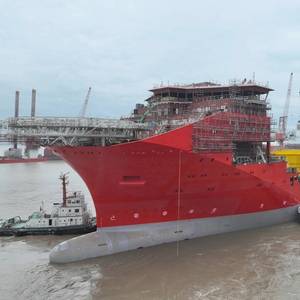
Belgian marine contractor Jan De Nul has launched its newest cable laying vessel (CLV), the Fleeming Jenkin, at the CMHI Haimen shipyard in China, which has now entered the final phase of construction ahead of delivery planned for second half of 2026.The 215-meter-long vessel has a loading capacity of 28,000 tonnes, making it the world’s largest of its kind.
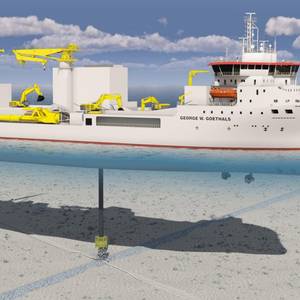
Subsea technology company Seatools has been awarded a contract by Jan De Nul for the design and delivery of a Fall Pipe ROV (FP-ROV) that will form a key system of the Belgian contractor’s recently ordered subsea rock installation vessel, the George W. Goethals.The ROV will play an essential role in the vessel’s mission to protect critical subsea infrastructure by enabling highly accurate and
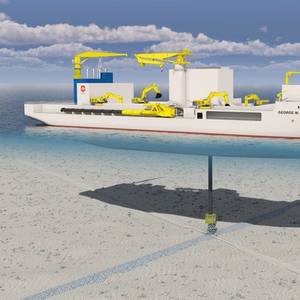
Remazel, a company of the Fincantieri Group, has signed a contract with Jan De Nul for the supply of mission-critical equipment for a newbuild vessel.The contract covers the design and supply of an advanced system for transporting and laying rocks on the seabed to protect cables and pipelines.
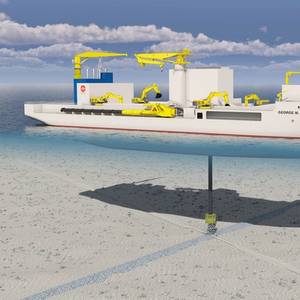
Belgian marine contractor Jan De Nul has ordered a rock installation vessel, specifically built to strengthen the protection of offshore energy and subsea data infrastructure.The vessel, named George W. Goethals, will be the company’s largest rock installation ship to date, with a carrying capacity of 37,000 tonnes.