

The U.S. Navy’s Military Sealift Command is a critical part of the United States’ national security equation, as any navy only goes as far as its supply chain allows. RADM Benjamin Nicholson, Commander, U.S. Navy Military Sealift Command, visited with Maritime Matters: The MarineLink Podcast, for a deep discussion on MSC

The United States is having a maritime moment. Maritime is back on the national agenda. The Maritime Action Plan, the SHIPS for America Act,and now the Administration’s August 13 memorandum on rebuilding the Navy and America’s shipbuilding industrial base have renewed the conversation about rebuilding America's maritime capability.

Oman has presented Iran with a plan backed by Gulf states to manage the Strait of Hormuz, including collecting voluntary fees for using it, a Gulf source and a Western diplomat told Reuters on Tuesday.The plan could serve as a basis to end the disruption to trade through the strait caused by the U.S.-Israeli war on Iran.President Donald Trump, who abruptly called off a two-week U.S.

Dubai-based GMS has won U.S. government approval to scrap four container ships that were under Iran-related sanctions, potentially paving the way for Washington to reduce the shadow fleet of such vessels, the leading ship recycler's CEO said.Hundreds of ships with no known insurance or compliance with environmental safety standards have not only helped Iran and Russia circumvent sanctions

Security is all too often treated as a purely compliance-driven exercise. This isn’t advisable in any industry, but it is particularly damaging for those that fall under critical infrastructure frameworks. Ports, and, by extension, the dredging operations that maintain and expand shipping lanes, are the backbone of global trade, underpinning essential supply lines.

Shippers on Wednesday said they needed more clarity on the terms of the U.S.-Iran ceasefire before resuming transit through the Strait of Hormuz, as Iran said the waterway remained closed to vessels sailing without a permit.The six‑week conflict had brought traffic through the strait - a chokepoint for about 20% of global oil and liquefied natural gas (LNG) shipments - close to a standstill

Bahrain has put forward a draft U.N. Security Council resolution that would authorise countries to use "all necessary means" - diplomatic language for force - to protect commercial shipping in and around the Strait of Hormuz, according to a text seen by Reuters on Monday.Diplomats said the draft text was backed by other Gulf Arab states and the United States

The United States and French energy major TotalEnergies said on Monday they would redirect nearly $1 billion from offshore wind leases to U.S. oil and natural gas production.The agreement marks a new strategy in the Trump administration's wide-ranging effort to stymie development of U.S. offshore wind projects, which President Donald Trump has said he finds ugly, costly and inefficient.

Iran said on Sunday it would strike the energy and water systems of its Gulf neighbours in retaliation if U.S. President Donald Trump follows through with a threat to hit Iran's electricity grid in 48 hours, escalating the three-week-old war.The prospect of tit-for-tat strikes on civilian infrastructure could deepen the regional crisis and further rattle global markets when they reopen on Monday

Often debated and long-awaited, The White House released its long-anticipated America’s Maritime Action Plan (MAP), a 40+ page blueprint aimed at what it calls a new “Maritime Golden Age” for the United States.The document, developed under Executive Order 14269, lays out a four-pillar strategy to rebuild domestic shipbuilding capacity, expand the U.S.

The White House has ordered U.S. military forces to focus almost exclusively on enforcing a "quarantine" of Venezuelan oil for at least the next two months, a U.S. official told Reuters, indicating Washington is currently more interested in using economic rather than military means to pressure Caracas.
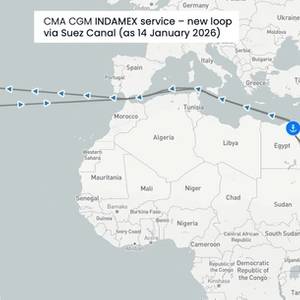
Major carrier CMA CGM has announced its INDAMEX service will transit Suez Canal on fronthaul and backhaul voyages between India/Pakistan and US East Coast in a notable step towards a largescale return of container ships to the Red Sea region.The first vessel to complete a full service loop via Suez Canal will be CMA CGM Verdi, sailing from Karachi to New York on 15 January.