

Shippers' appetite for lower-carbon marine fuels weakened this year as the fate of a regulatory emissions framework from the International Maritime Organization (IMO) remained cloudy while some are using carbon credits, industry executives said.IMO member nations are set to meet by early November on the formal adoption of a net-zero framework to guide the industry towards zero carbon emissions

Shipowners have already ordered more than twice as many supertankers this year as in all of 2025, a buying spree worth over $20 billion that is the biggest for at least 25 years, as the US-Iran war redraws trade routes and boosts demand for long-haul crude shipments.Data from Signal Group, a shipping analytics platform, show 217 Very Large Crude Carriers ordered so far in 2026

The U.S. is expanding its icebreaking fleet to strengthen Arctic and domestic access, and support commercial shipping, seabed resources, subsea cables and fisheries. Current plans include 1–3 heavy Polar Security Cutters (PSCs), 11 medium Arctic Security Cutters (ASCs), seven Homeland Security Cutter (HSC) HSC-L (light) icebreakers, 11 HSC-Ms (medium) and one additional heavy HSC-H (heavy).

Stephen M. Carmel & MarAd are aiming to make this U.S. Maritime Rebuild StickFor anyone who has spent a career in the U.S. maritime industry, the past two years have been unusual by any metric. Maritime has moved from the far margins of federal policy discussions to center stage, with rebuilding American shipbuilding

Part of a group of companies that make up Fraser Industries, Fraser Shipyard is a 138-year-old on Lake Superior, an organization which makes equal revenue from newbuild and ship repair, able to work in both steel and aluminum. Recently it signed a collaboration agreement with HD Hyundai to help migrate process and technology from one of the world’s biggest and best shipyard to the shores of Lake

On the release of a new ABS report “Decision Point: Practical Pathways to 2035” John McDonald, ABS Chairman and CEO, explains: “The industry has entered a new phase. For many years, the discussion centered on identifying a future fuel winner. Today, the challenge is broader. Shipping companies are making investment decisions for assets that will operate into the 2040s

The American Great Lakes Ports Association has signed a Memorandum of Understanding (MoU) with the Great Lakes Alliance of Shipyards to advance shared priorities in domestic shipbuilding and commerce.The MoU marks the first formal partnership between the U.S. Great Lakes port and shipyard communities.

CHICAGO — July 30, 2026 — The United States cannot rebuild its maritime strength by focusing solely on its ocean coasts. Instead, the nation's industrial resurgence depends on recognizing the Great Lakes as one of America's five maritime coastlines and leveraging the region's unmatched manufacturing ecosystem, according to U.S. Maritime Administrator Stephen M. Carmel.

The world's oil tanker fleet is behaving as if the Strait of Hormuz is reopening — even as the waterway itself remains only partially navigable and politically contested. From ship tracking data to freight rates, the signals are clear: owners and charterers are moving early to position vessels for a return to Gulf exports.

Long-distance ferry routes form a key part of Japan’s national transport infrastructure, connecting the archipelago’s four major islands and littoral centers of population, commerce and industry.RoRo passenger (RoPax) ferry fleet renewal and development has been a constant process over the past two decades in particular

Great Lakes Dredge & Dock Corporation and Saltchuk Resources, Inc. announced a definitive agreement for Saltchuk to acquire Great Lakes at an aggregate equity value of approximately $1.2 billion and a total transaction value of $1.5 billion.Under the terms of the agreement, which has been unanimously approved by the Board of Directors of both companies
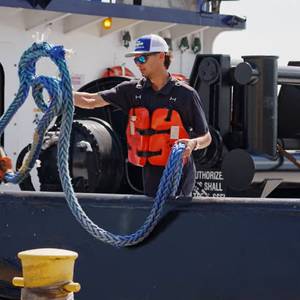
The American Waterways Operators, the trade association of the American tugboat, towboat and barge industry, has released a new video on the industry's contributions to U.S. national and homeland security.The two-minute video, The Tugboat, Towboat and Barge Industry: Supplying America, Securing America, notes that while the mariners who transport cargo and facilitate commerce on America's rivers