

Accelerating demand for subsea power and telecoms cable network construction is fuelling major expansion of the world fleet of purpose-designed cable laying, maintenance and repair vessels.Driven by the growth of the offshore renewables sector and its advance into deeper waters, as well as by widening investment in cables connecting electrical grids in different countries

Singapore-based OMS Group has secured $1.0315 billion in corporate and export credit agency-backed financing facilities, supporting a fleet expansion that includes four new fibre-optic cable-laying vessels scheduled for delivery in 2027 and 2028.The financing package comprises $911.
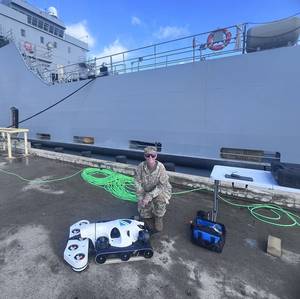
Sticking to legacy tactics won't beat China — adopt Secretary Hegseth's and the Army initiatives or surrender the edge.In a recent address, Admiral Christopher Grady, Vice Chairman of the Joint Chiefs of Staff, underscored the urgent need for a robotic hull-cleaning system to enable anytime maintenance, reduce drag, boost speed, and minimize fuel consumption for naval vessels.

Northwest Florida has long been defined by its connection to the water. Home to Naval Air Station Pensacola, the Port of Pensacola and a growing network of marine manufacturers, defense contractors and emerging technology companies, the region is an important center for maritime innovation.

OMS Group has started construction of CS Resilience, the third vessel in its next-generation GREAT-Class fleet, with a first steel cutting ceremony held at CRIST's shipyard in Gdynia, Poland.The milestone marks the start of construction of the cable-laying vessel, which is scheduled to enter service in 2028 and forms part of OMS Group's long-term fleet expansion program.

The outlook for the offshore support vessel (OSV) business has brightened considerably since the dark days of the previous decade and is possibly in a “Goldilocks moment” — not too weak and not too strong. While strengthening, it has not yet reached the point of significant new vessel ordering. Paradoxically, across maritime markets, observers are often concerned when exuberance gets out of hand.

U.S. President Donald Trump ordered on Tuesday a "blockade" of all sanctioned oil tankers entering and leaving Venezuela, in Washington's latest move to increase pressure on Nicolas Maduro's government, targeting its main source of income.It is unclear how Trump will impose the move against the sanctioned vessels