

Introduction. Looking back at history one could argue that it was French author Jules Verne in his book “20,000 Leagues Under the Sea”, published in 1869, who was speculating about a new power source much in the same out of the box thinking that H.G. Wells employed when he wrote about inter-planetary flight in “War of the World’s.

By Captain Bobbie Scolley, U.S. Navy (ret.) and Rear Admiral Tim Gallaudet, U.S. Navy (ret.)For more than six decades, spanning from 1905 to the late 1970s, the U.S. Navy’s diving apparatus for deep ocean operations and salvage remained fundamentally unchanged. During this period, the demographic of navy divers also saw little alteration.

J.F. Brennan Company (Brennan) has acquired the marine operations of Budrovich Contracting Co., Inc., establishing a permanent presence in St. Louis and building on its longstanding relationships in the region.The acquisition builds on a seven-year relationship between Brennan and Budrovich’s Marine Operations team.

The most important advisory body concerning the Nation’s inland waterways infrastructure is the Inland Waterways Users Board (IWUB), a Congressionally mandated, non-discretionary advisory committee established in the Water Resources Development Act (WRDA) of 1986 and codified by 33 U.S.C. § 2251.

Myanmar's new government aims to complete within roughly eight years a contentious $3.6 billion dam project at Myitsone in northern Kachin state, said two sources with knowledge of comments by Khet Htein Nan, who leads the state administration.The comments came after junta chief turned president Min Aung Hlaing returned from a visit last month to China

As the national public policy organization that advocates for a modern, reliable, efficient inland waterways and ports system, Waterways Council, Inc. (WCI) continually seeks ways to improve the delivery of inland waterways navigation projects managed by the U.S. Army Corps of Engineers.

New Zealand has shortlisted contractors to build a liquefied natural gas (LNG) import facility to boost energy security, provide a reliable backup power source and support economic growth, Energy Minister Simon Watts said on Monday.The government aims to sign a contract by the middle of this year for an import facility in Taranaki, on the country's North Island

As Americans do each year, with 2026 just the same, we are hopeful for a more promising year, with better outcomes and calmer seas. But for construction of the Nation’s inland waterways lock and dam infrastructure, there is a strong sense of urgency like never before.Since 1987, just 10 projects to modernize or expand locks on the inland waterways system have been completed

Waterways Council, Inc. released a study by HDR, Inc. (Recommendations for Improving the Delivery of Inland Waterway Capital Projects and accompanying infographic) that examines why costs for U.S. inland waterways capital projects (locks and dams) escalate, timelines for completion continue to slip, and economic benefits to the Nation from projects’ execution are consistently delayed. The U.S.

For Major General Jason Kelly, Rebuilding and Maintaining the Nation’s Critical Waterway Infrastructure is personal.When Major General Jason Kelly reflects on his path to leading the United States Army Corps of Engineers’ (USACE) Civil Works mission, he doesn’t describe a straight line.

The U.S. Army Corps of Engineers Civil Works mission began in 1824 when our Nation’s fifth President, James Monroe, signed into law a bill to improve navigation on the Ohio and Mississippi Rivers. While Corps projects have always been large and complex, the Civil Works missions have evolved over time to incorporate new regulations, policies, shifts from political pressures, and unfortunately
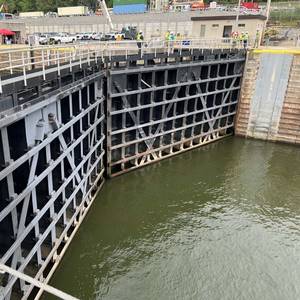
The path toward funding the U.S. Army Corp of Engineers (USACE) – and the critical inland infrastructure maintenance and construction of locks and dams that it does – is neither straight nor clear. Jen Armstrong, VP, Government Relations, Waterways Council, visited recently with Maritime Reporter TV to discuss in detail the historical context of how USACE funding has evolved in the past 50 years.