

Northern Lights joint venture has taken delivery of its fourth dedicated liquefied CO2 (LCO2) carrier, completing the vessel fleet required for the first phase of its carbon capture and storage (CCS) transport and storage operations.The Northern Purpose has arrived in Norway following delivery from Dalian Shipbuilding Offshore Company (DSOC), joining sister vessels Northern Pioneer

A new liquid carbon dioxide (LCO2) transfer solution built on proven technology from MacGregor enables the flexible, direct ship-to-well injection needed to support the EU’s carbon capture and storage goals.If the European Union is to meet its objective of net-zero emissions by 2050, carbon capture and storage (CCS) will have a significant part to play.

Offshore floating solar company SolarDuck and the Maritime Research Institute Netherlands (MARIN) have been awarded a USD$3.64 million (€3.2 million) subsidy from the Netherlands Enterprise Agency (RVO) for the Steady Seas research program. The project will advance the foundational design of SolarDuck's Offshore Floating Power & Utility Hub (OFPH)

Northern Lights JV has awarded a consortium comprising Kawasaki Kisen Kaisha (“K" LINE) and Malaysia's MISC Berhad a time charter contract for a newly built 12,000 cubic meter liquefied CO2 (LCO2) carrier, supporting the expansion of Europe's carbon capture and storage (CCS) infrastructure.

Bernhard Schulte has christened its first liquefied CO2 (LCO2) carrier, marking the company’s entry into the carbon capture and storage (CCS)-related shipping segment.The vessel, named Northern Purpose, was christened on May 19 at Dalian Shipbuilding Offshore (DSOC) in China and will support the Northern Lights CCS project, a cross-border CO2 transport and storage development in Norway.

NYK has signed a memorandum of understanding (MoU) with Hokkaido Electric Power to conduct a study related to onboard carbon capture and storage (OCCS) technologies.Under the agreement, the companies will jointly study a demonstration project in Tomakomai, Japan, focused on decarbonizing maritime transport.

Toyo Engineering Corporation has signed a memorandum of understanding with OneSubsea to explore collaboration in subsea carbon capture and storage (CCS) projects.The agreement aims to combine the companies’ capabilities to develop integrated system solutions for subsea CCS, focusing initially on projects in Japan and Southeast Asia.

The Northern Lights JV has added a third liquefied carbon dioxide (LCO2) carrier to its fleet, as it expands transport capacity for Europe’s carbon capture and storage (CCS) network.The vessel, Northern Phoenix, was formally welcomed in Bergen and will support the scaling of cross-border CO2 transport under the Northern Lights project.

Chiyoda Corporation, NYK Line and Knutsen NYK Carbon Carriers (KNCC) have signed a memorandum of understanding to collaborate on carbon capture and storage (CCS) projects globally.Under the agreement, the companies will work together to expand CCS business opportunities in Japan and overseas, including optimizing transportation methods for liquefied carbon dioxide.

ClassNK has granted Approval in Principle (AiP) for the design of a liquefied CO2 carrier intended to support a floating offshore carbon capture and storage (CCS) injection facility.The vessel is designed to serve a Socket SPAR unit, a floating injection system being considered for deployment in deepwater environments where subsea pipeline-based CO2 storage is not feasible.

Tampnet won a contract with Porthos CO2 Transport and Storage C.V. to deliver communications infrastructure for what will be the first CO₂ injection platform on the Dutch Continental Shelf.The project centers on Platform P18-A, a former gas production asset being converted into an unmanned installation for carbon storage as part of the broader Porthos CCS Project.
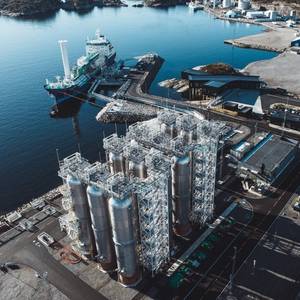
Technip Energies Loading Systems has secured a contract to supply three fully electric marine loading arms for phase 2 of the Northern Lights CO2 transport and storage project in Øygarden, Norway.The loading solution will be installed at the new Northern Lights jetty and will consist of three marine loading arms fully qualified to transfer liquefied CO2.