

Norwegian shipbuilder Vard has delivered a hybrid construction and cable laying vessel (CLV) to Japan's Toyo Construction, marking its first vessel delivery to the Japanese offshore wind market.The vessel was handed over at Vard Langsten in Norway on June 26. It is also the first vessel Toyo Construction has ordered from Vard.

Equinor has decided to end its offshore wind business activities in Japan, where it has been since 2018 but has failed to win any leases in successive auctions, and close its Tokyo office by the end of 2026.Orsted, the world's largest offshore wind developer, exited Japan in 2024 and Equinor has previously scaled back offshore wind development in markets including Vietnam, Spain

DEME, through its Japanese joint venture Japan Offshore Marine (JOM), has secured a contract for the Oga–Katagami–Akita Offshore Wind Project, covering engineering work and vessel charter services for the offshore installation of 21 wind turbines.The contract forms part of an agreement between Oga Katagami Akita Offshore Green Energy and Penta-Ocean Construction.

Panama-flagged tanker Idemitsu Maru, carrying 2 million barrels of Saudi oil, crossed the Strait of Hormuz, LSEG shipping data showed on Tuesday, becoming the first Japan-linked crude tanker to do so since the Iran war began.Before the U.S.-Iran conflict broke out on February 28 and disrupted Middle East crude oil and liquefied natural gas supplies

Continuous design refinement and incremental productivity gains — reflecting the Japanese concept of kaizen — alongside unremitting attention to contractual performance and product quality have seen the country’s shipbuilders maintain a high profile in certain sectors of the commercial vessel market.

Iran said on Sunday it would strike the energy and water systems of its Gulf neighbours in retaliation if U.S. President Donald Trump follows through with a threat to hit Iran's electricity grid in 48 hours, escalating the three-week-old war.The prospect of tit-for-tat strikes on civilian infrastructure could deepen the regional crisis and further rattle global markets when they reopen on Monday

Three vessels have been hit by unknown projectiles in the Strait of Hormuz, maritime security agencies and sources said on Wednesday, as one of the strikes led to a fire onboard a ship and forced most of its crew to evacuate it.The Thailand-flagged bulk carrier Mayuree Naree was targeted and damaged approximately 11 nautical miles north of Oman, two maritime security sources said.

Long-distance ferry routes form a key part of Japan’s national transport infrastructure, connecting the archipelago’s four major islands and littoral centers of population, commerce and industry.RoRo passenger (RoPax) ferry fleet renewal and development has been a constant process over the past two decades in particular

Kawasaki Heavy Industries and Japan Suiso Energy have signed a contract to build the world’s largest liquefied hydrogen carrier, marking a step toward the commercialization of an international hydrogen supply chain.The vessel will have a cargo capacity of about 40,000 cubic meters and will be built at Kawasaki Heavy Industries’ Sakaide Works in Kagawa Prefecture.

Japan will conduct test mining of rare-earth-rich mud from the deep seabed off Minamitori Island, some 1,900 kilometres (1,180 miles) southeast of Tokyo, from January 11 to February 14, the head of the government-backed project said.The operation will mark the world's first attempt to continuously lift rare-earth mud from a depth of around 6,000 meters on to a vessel.
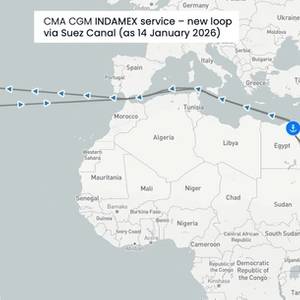
Major carrier CMA CGM has announced its INDAMEX service will transit Suez Canal on fronthaul and backhaul voyages between India/Pakistan and US East Coast in a notable step towards a largescale return of container ships to the Red Sea region.The first vessel to complete a full service loop via Suez Canal will be CMA CGM Verdi, sailing from Karachi to New York on 15 January.
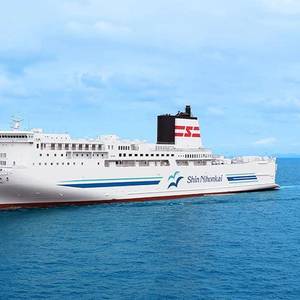
Mitsubishi Shipbuilding delivered the large car ferry KEYAKI, built for Shin Nihonkai Ferry Co., Ltd. and Japan Railway Construction, Transport and Technology Agency (JRTT), at the Enoura Plant of MHI's Shimonoseki Shipyard & Machinery Works in Yamaguchi Prefecture on the November 11, 2025.