

At least four oil and gas tankers have turned back from attempting to transit the Strait of Hormuz, ship-tracking data showed, as renewed attacks on vessels in the critical waterway heightened safety and security concerns.The diversions come after a Qatari liquefied natural gas tanker and a Saudi-flagged crude oil tanker were damaged near the strait on Tuesday following reports that Iran fired

Many claim to have ‘saltwater in their veins,’ but all you have to do is walk into the corner office of John McDonald, the new Chairman and CEO of the American Bureau of Shipping (ABS), to see that him saying “I was born into maritime” is not hyperbole. The first thing that greets you is a Dusan Kadlec nighttime painting of the Brooklyn Bridge

Eastern Shipbuilding Group, Inc. (ESG) announced the launch of the fourth annual Eastern Shipbuilding Group Coastline Initiative. In partnership with the Bay County Artificial Reef Association (BCARA), the competition challenges students from local welding schools to design and construct artificial reefs that support coastal restoration and marine habitat preservation.

Crowley, a provider of logistics, marine and energy solutions, announced a new weekly container service connecting Port Houston to Santo Tomás de Castilla, Guatemala, and Puerto Cortés, Honduras, two of Central America’s largest and fastest-growing trade gateways.The Gulf-Central America Express Service makes its first Houston call on Sept. 10 with Thursday departures.

Carnival Cruise Line (CCL) has signed an agreement with Jotun to implement Hull Skating Solution (HSS), becoming the first cruise operator to use this robotic proactive hull cleaning technology. With this commitment, Carnival continues to utilise innovation and technology to reduce emissions and protect biodiversity.

Western Illinois University announced the formal establishment of the Corn Belt Ports Rural Logistics & Maritime Training & Education Consortium, a multi-state collaboration designed to strengthen the inland maritime workforce and support economic growth across the Midwest.The Consortium brings together a broad network of institutions of higher education from Illinois, Iowa, Missouri

ZIM Integrated Shipping Services Ltd. announced that Mr. Eli Glickman, the President and Chief Executive Officer of the Company, informed the Board of Directors of his decision to depart from the Company. Mr.Glickman will continue to serve as Chief Executive Officer of the Company during a six-month notice period

With powerful winter storms, it’s easy to focus on what’s happening at the surface: snowfall totals, wind chills, and travel impacts. But the real story often begins thousands of miles away, high in the atmosphere, long before the first flakes ever fall.In March 2026, a major winter storm swept across the Midwest United States, and it didn’t start with snow or wind at all.

Port Milwaukee welcomed the Marshall Islands-flagged Federal Nagara as the first vessel of the 2026 international season on Friday, April 3.The Federal Nagara arrived at the Logistec terminal to unload specialty steel products following its transit through the St. Lawrence Seaway from Spain and Belgium, where it was loaded. The St.

Incat Crowther was commissioned by South Korean shipbuilder Kangnam Corporation (Kangnam) to design a new 80-m high-speed catamaran RoPax ferry for operation by Korea Express Ferry (KEF). The new vessel will service routes between Incheon Metropolitan City and the Yellow Sea islands of Daecheongdo, Baengnyeongdo and Socheongdo in Ongjin County, Republic of Korea (South Korea).

For Capt. Paul C. LaMarre III, the maritime industry isn’t a career choice as much as it is a family inheritance — and, in his words, “all I’ve known my entire life.” In a recent interview with Maritime Reporter TV, Captain LaMarre gives unique insights on the operating efficiently, effectively and safely on the Great Lakes system – the United States’ ‘Fourth Sea’ – and with passion
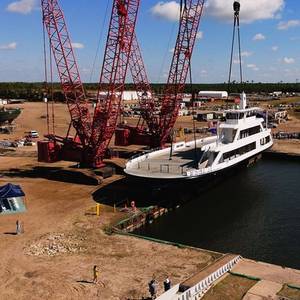
Eastern Shipbuilding Group launched the vehicle-passenger ferry FALCON, being constructed for the Fisher Island Community Association (FICA).The ferry is designed to meet the unique needs of the Fisher Island route, combining enhanced vehicle capacity and passenger comfort with ESG’s proven vessel-construction expertise.