

China's state-owned shipping giant COSCO uses concealed equipment on board its ships to spy on military communications near the coastlines of target nations including the U.S., two senior Trump administration officials said.The officials, who spoke on condition of anonymity to discuss the U.S.

On the release of a new ABS report “Decision Point: Practical Pathways to 2035” John McDonald, ABS Chairman and CEO, explains: “The industry has entered a new phase. For many years, the discussion centered on identifying a future fuel winner. Today, the challenge is broader. Shipping companies are making investment decisions for assets that will operate into the 2040s

The United States, Britain and Australia are working together to develop unmanned undersea vehicles as part of their trilateral AUKUS defence pact, U.S. Secretary of Defense Pete Hegseth told reporters on Saturday.AUKUS said in a joint statement that delivery of the vehicles will start in 2027.

Anemoi Marine Technologies’ Rotor Sail wind-assisted propulsion system has completed more than eight years of continuous commercial operation after M/V Afros successfully passed its second intermediate dry dock survey.The survey, conducted by Lloyd’s Register in China in April, confirmed the structural integrity and operational condition of the vessel’s four Rotor Sails, Anemoi said.

Many claim to have ‘saltwater in their veins,’ but all you have to do is walk into the corner office of John McDonald, the new Chairman and CEO of the American Bureau of Shipping (ABS), to see that him saying “I was born into maritime” is not hyperbole. The first thing that greets you is a Dusan Kadlec nighttime painting of the Brooklyn Bridge

Dorian LPG took delivery of its 93,000 cubic meter (cbm) dual-fuel newbuilding named Areion an LPG and ammonia very large gas carrier (VLGC/AC) from Hanwha Ocean Heavy Industries Co., Ltd. at the Okpo Shipyard in South Korea. Areion will commence employment on charter under the Helios LPG Pool, an entity jointly controlled by Dorian LPG Ltd and MOL Energia Pte Ltd.

A Quick Q&A with Port of the Future Founder and Event Director Kevin Clement on key differentiators and the value of attending, exhibiting and speaking at Port of the Future 2026:CLICK HERE to discover the conference line-up and to register for Port of the Future 2026 in Houston, March 23-25.Q: What inspired the creation of the Port of the Future Conference?The idea started in 2019 with Dr.

Swan Defence and Heavy Industries (SDHI) has signed its first newbuild contract for six IMO Type II chemical tankers, marking a milestone for India’s commercial shipbuilding sector and the country’s first chemical tanker order placed with a domestic shipyard.The contract, valued at $227 million, was awarded by European shipowner Rederiet Stenersen AS and covers six 18

The quest to rebuild the U.S. iceabreaking fleet continues to move at lightening speed, with Seaspan Shipyards (Seaspan) signing agreements with Bollinger Shipyards (Bollinger) and Rauma Marine Constructions Oy (Rauma) to provide its Multi-Purpose Icebreaker (MPI) design and associated supply chain packages to enable rapid construction and delivery of up to six vessels for the U.S.

The White House has ordered U.S. military forces to focus almost exclusively on enforcing a "quarantine" of Venezuelan oil for at least the next two months, a U.S. official told Reuters, indicating Washington is currently more interested in using economic rather than military means to pressure Caracas.
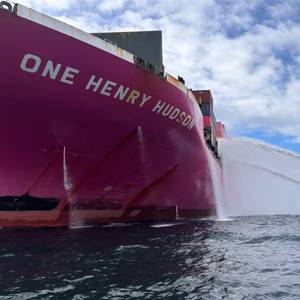
Firefighters and federal authorities continued working Saturday to contain a hazardous-materials fire aboard the container ship ONE Henry Hudson after an explosion and onboard fire forced the evacuation of all crew members at the Port of Los Angeles, according to the Los Angeles Fire Department (LAFD) and port officials. By 6:30pm local time, the fire had been substantially contained.

The ABS Board of Directors has elected John McDonald as the new Chairman and Chief Executive Officer of ABS at a board meeting on November 11.In the culmination of a well-planned succession process, McDonald, the serving ABS President and Chief Operating Officer, will take over on January 1, 2026, when present ABS Chairman and CEO Christopher J. Wiernicki retires.