
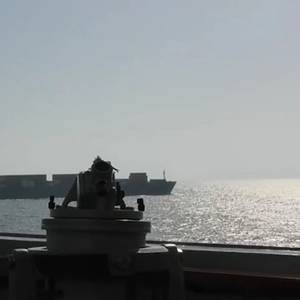
Concerns grew on Monday that the ceasefire between the United States and Iran might not hold after the U.S. said it had seized an Iranian cargo ship that tried to run its blockade and Iran vowed to retaliate.Efforts to build a more lasting peace in the region likewise appeared to be on shaky ground, as Iran said it would not participate in a second round of negotiations that the U.S.

President Donald Trump said on Sunday the U.S. Navy would start blockading the Strait of Hormuz, raising the stakes after marathon talks with Iran failed to reach a deal to end the war, jeopardizing a fragile two-week ceasefire.The U.S. Central Command said U.S. forces would begin implementing the blockade of all maritime traffic entering and exiting Iranian ports at 10 a.m.

Oil prices settled lower on Wednesday following a choppy session after the International Energy Agency agreed to speed up a release of oil stocks and prioritize diesel in a bid to curb record-high fuel prices as the Iran war squeezes global supplies.Brent crude futures LCOc1 settled down 38 cents, or 0.38%, at $100.20 a barrel. US West Texas Intermediate (WTI) crude futures CLc1 settled down $1.

Oil prices fell on Wednesday as optimism over U.S.-Iran talks eased supply concerns after U.S. President Donald Trump said meetings in Qatar had gone well.Brent futures were down 95 cents, or 1.30%, to $72.00 a barrel at 0119 GMT. U.S. West Texas Intermediate crude was down 54 cents, or 0.78%, at $68.96 a barrel — its lowest since February 27.

Oil prices fell 4% on Monday after U.S. Vice President JD Vance said progress has been made in talks with Iran and that the Strait of Hormuz was open, easing supply concerns.Brent crude was down $3.18 or 3.95%, at $77.39 a barrel by 11:44 a.m. ET (1544 GMT) Prices had climbed to $82.30 at the start of trading because of threats from U.S.

Oil shipments through the Strait of Hormuz picked up on Friday after the United States and Iran signed a ceasefire deal, with Gulf producers preparing to raise exports despite concerns over conditions set by Tehran for using the vital waterway.Washington and Tehran released the text of an interim agreement signed on Wednesday to end the conflict, although U.S.

Oil prices rose on Friday as the prospect of a lasting truce between the U.S. and Iran was clouded after peace talks in Switzerland were called off and as Israel stepped up attacks on Lebanon.By 0645 GMT, Brent crude futures LCOc1 gained 51 cents, or 0.64%, to $80.36 a barrel, and U.S. West Texas Intermediate crude CLc1 rose $1.28, or 1.7%, to $77.

The United States and Iran have signed a memorandum of understanding to settle a near four-month war, senior U.S. officials said on Monday, adding that a signing ceremony would take place on Friday and shipping traffic in the strait of Hormuz would gradually ramp up.The memorandum of understanding has been signed by President Donald Trump and Vice President JD Vance and Iranian parliament

The American Association of Port Authorities (AAPA) Board of Directors announced the appointment of Sang Yi as President and Chief Executive Officer (CEO), effective May 4.Most recently, Yi served as Deputy Administrator of the U.S. Department of Transportation’s Maritime Administration (MARAD), where he oversaw key programs supporting the nation’s commercial and strategic maritime infrastructure.

Oil prices pared gains on Tuesday after briefly climbing above $100 a barrel following an announcement from U.S. President Donald Trump that he was extending a ceasefire with Iran until Tehran submits a proposal.Brent crude futures were volatile, settling up about 3% on Tuesday and then climbing further to rise more than 5% to a session high of $101.15 after reports that U.S.

A major Ukrainian attack on Russia's Black Sea port city of Novorossiysk hit warships at a naval base and forced two major grain terminals to halt operations on Wednesday, according to Russian and Ukrainian officials as well as grain industry sources.The Ukrainian attacks killed at least two people, including an 8-year-old child, regional Governor Veniamin Kondratyev said.

Iran issued a notice to airmen (NOTAM) that it plans rocket launches in areas across its south on Thursday from 330 GMT to 1330 GMT, the U.S. Federal Aviation Administration website showed on Wednesday.Iran conducted navy drills this week in the Hormuz Strait and plans to conduct a joint naval exercise with Russia on Thursday.