

Rescuers were searching for seven missing crew on Thursday from one of two chemical tankers that caught fire overnight inside Romanian territorial waters in the Black Sea, after Russian drones strayed into Romanian airspace, Romanian officials said.Romanian officials stopped short of explicitly linking the fires onboard the ships to the Russian drones.

Eleven sailors were missing at sea on Tuesday from a ship sunk by a drone attack off the coast of Bulgaria, possibly the second deadly sinking of a cargo vessel in the area in a week, prompting Bulgaria to summon Russia's ambassador.Two cargo ships were hit by drones overnight and one was sunk, Bulgarian officials said.

Stephen M. Carmel & MarAd are aiming to make this U.S. Maritime Rebuild StickFor anyone who has spent a career in the U.S. maritime industry, the past two years have been unusual by any metric. Maritime has moved from the far margins of federal policy discussions to center stage, with rebuilding American shipbuilding

Deep in Arctic waters near the remote Svalbard archipelago this spring, NATO allies caught Russian subs training to unleash a secret weapon designed to disable critical undersea cables without leaving any fingerprints.The clandestine Russian operation, described to Reuters by two Western officials, was carried out by Moscow's GUGI undersea warfare directorate

The U.S. military said on Monday it destroyed six Iranian small boats and intercepted Iranian cruise missiles and drones as Tehran sought to thwart a new U.S. naval effort to open shipping through the Strait of Hormuz.U.S. President Donald Trump launched the operation, called Project Freedom, on Monday as he sought to wrest control of the critical waterway from Iran

Many claim to have ‘saltwater in their veins,’ but all you have to do is walk into the corner office of John McDonald, the new Chairman and CEO of the American Bureau of Shipping (ABS), to see that him saying “I was born into maritime” is not hyperbole. The first thing that greets you is a Dusan Kadlec nighttime painting of the Brooklyn Bridge

Iran said on Sunday it would strike the energy and water systems of its Gulf neighbours in retaliation if U.S. President Donald Trump follows through with a threat to hit Iran's electricity grid in 48 hours, escalating the three-week-old war.The prospect of tit-for-tat strikes on civilian infrastructure could deepen the regional crisis and further rattle global markets when they reopen on Monday

Often debated and long-awaited, The White House released its long-anticipated America’s Maritime Action Plan (MAP), a 40+ page blueprint aimed at what it calls a new “Maritime Golden Age” for the United States.The document, developed under Executive Order 14269, lays out a four-pillar strategy to rebuild domestic shipbuilding capacity, expand the U.S.

HII’s Newport News Shipbuilding division is marking 140 years of service to the US today, January 28, 2026.On Jan. 28, 1886, Collis P. Huntington, a businessman whose investments enabled completion of the U.S. transcontinental railroad, turned his focus to shipbuilding, establishing what was first chartered as Chesapeake Dry Dock and Construction Co.

As global demand for data storage and processing accelerates — driven by cloud computing, streaming media, and the explosive growth of artificial intelligence — the physical footprint of data centers has become a growing challenge. Land-based facilities face mounting constraints: limited space, water scarcity, grid congestion, long permitting timelines and rising community opposition.

The U.S. inland waterways don’t just move cargo — they move people into long-term, well-paid careers. At a time when trucking and rail struggle with shortages, turnover, and burnout, inland waterways operators quietly offer something different: a job you can start without experience, a career you can grow into, and a paycheck that gets better every step of the way.
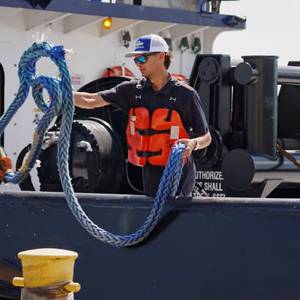
The American Waterways Operators, the trade association of the American tugboat, towboat and barge industry, has released a new video on the industry's contributions to U.S. national and homeland security.The two-minute video, The Tugboat, Towboat and Barge Industry: Supplying America, Securing America, notes that while the mariners who transport cargo and facilitate commerce on America's rivers