

Bibby Marine has launched its new battery-first electric commissioning service operation vessel (eCSOV) at Armon Shipyard in Vigo, Spain, ahead of its planned delivery in 2027.The vessel, which will carry the name Staffordshire, entered the water on October 10 and will undergo further outfitting at the shipyard over the coming months, including the installation of its battery systems.

Batteries have become a practical part of maritime decarbonization. They are used on ferries, harbor craft, tugs, offshore support vessels, crew transfer vessels, various types of remotely operated vessels, and hybrid ships to reduce fuel burn, provide spinning reserve, support dynamic positioning, enable peak shaving, and allow zero-emission operation in port.

Kongsberg Maritime and a consortium of leading Norwegian maritime companies and research institutions have launched WINTEGRATE, a project aimed at accelerating the adoption of wind propulsion in commercial shipping.The project has been awarded up to USD$7.3 million (NOK 68 million) through Norway's Green Platform program.

Corvus Energy AS, a provider of marine energy storage solutions, introduced Blue Whale NxtGen Power, a lithium iron phosphate (LFP) energy storage system developed together with BYD Energy Storage.Blue Whale NxtGen Power is the first product to come out of the strategic cooperation between Corvus Energy and BYD Energy Storage, announced in December 2025.

Corvus Energy will supply battery energy storage systems for four new hybrid-electric Summit Class ferries being built for BC Ferries, with a total initial installed capacity of 40 MWh.Each double-ended ferry will receive a 10-MWh Corvus Dolphin NxtGen battery system. Corvus will also provide battery interfaces and control systems designed to accommodate significant additional capacity

For much of the maritime industry, the energy transition has been discussed in terms of alternative fuels – primarily LNG, methanol, ammonia, or hydrogen. Batteries have often been treated as a narrow tool for limited-purpose vessels, such as water taxis and harbor craft. That view is becoming too constrained.The importance of batteries comes not from technology enthusiasm alone.

Vessel electrification is no longer a future concept for offshore wind and policy and regulatory alignment is now the main barrier to uptake, a cross-industry panel hosted by Bibby Marine told an audience during Global Offshore Wind on Wednesday.Speakers from RenewableUK, Corvus Energy, Stillstrom

German shipbuilder Meyer Werft has introduced a concept for what it says would be the world’s first fully battery-electric cruise ship exceeding 80,000 gross tons, signaling a bold step forward in the industry’s push toward decarbonization.The concept, dubbed “Vision,” was unveiled at Seatrade Cruise Global in Miami.
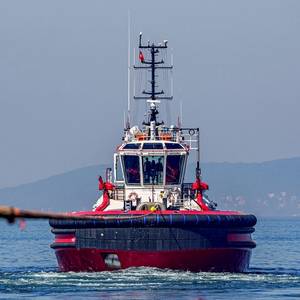
Sanmar Shipyards has announced the successful completion of sea trials for its 14th fully electric tugboat, marking an achievement in the company’s 50th-anniversary year. This latest vessel, an ElectRA 2500SX design, reinforces Sanmar’s position as a global leader in the transition toward a sustainable, emissions-free towage industry.

Corvus Energy, a provider of zero-emission energy solutions for the maritime industry, has received a record order from Remontowa Shipbuilding in Poland for the supply of battery systems for seven new fully electric ferries for Scottish Government owned Caledonian Maritime Assets Limited (CMAL) in Scotland.

German Naval Yards (GNY), Swisship Yacht Projects headed by Andreas Iseli and Kristian Pascoli of Pascoli International have announced their collaboration on a new 93-meter superyacht concept “KOA” aimed at the next generation of large-superyacht owners. With a beam of 14.60 meters, a draft of 4 meters and an internal volume of approximately 3,500 GT, the project balances modern aesthetics

BYD Energy Storage, a leader in the energy storage sector, and Corvus Energy AS, a leader in marine energy storage systems (ESS), announced the signing of a Memorandum of Understanding (MoU) to establish a strategic collaboration aimed at advancing next-generation battery solutions for the maritime sector.