

The barge Defiant was refloated from the Castillo San Felipe del Morro shoreline in San Juan Harbor, Wednesday at approximately 2:22 a.m., just before high tide.Salvage crews and tugboat operators prepositioned three tugboats and completed all the preparations, including the pressurization of all cargo tanks, voids and compartments in the barge.

The U.S. Coast Guard coordinated the rescue of 27 mariners on Saturday after their Venezuelan-flagged fishing vessel caught fire approximately 500 miles north-northwest of the Galapagos Islands, Ecuador.At 3:51 p.m. PST, Saturday, Rescue Coordination Center Alameda received a notification from the Garmin Search and Rescue Command Center of an SOS distress alert from the 240-foot fishing vessel
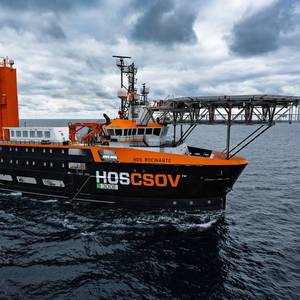
Eastern Shipbuilding Group (ESG) completed and redelivered HOS Rocinante, a first-of-its-kind U.S.-flagged Service Operation Vessel (SOV) converted for Hornbeck Offshore Services.The vessel marks a milestone in the evolution of the U.S. offshore service fleet to be future-ready for both the offshore wind and petro-energy sector demands for broadly capable marine support vessels.

C&C Marine and Repair delivered M/V Capt. Pete Ciaramitaro, a 2,600-horsepower inland towboat, to Southern Devall. The vessel is the first delivery from C&C Marine’s six-vessel spec towboat program and was delivered just over two months after the contract was signed on July 20, 2026.

The future of maritime safety will not be determined by a choice between people and technology but will instead depend on how effectively the industry combines them. Capt. Naoki Saito, General Manager and Head of the Cyber Security Ship Management Systems Department, ClassNK fully acknowledges the critical place mandatory procedures occupy in upholding consistent maritime safety

Capt. Jonathan Andrechik transferred command of Coast Guard Sector New York to Capt. Doreen McCarthy Monday, during a change-of-command ceremony at Sector New York in Staten Island. Rear Adm. Michael Platt, Commander, Coast Guard Northeast District, presided over the ceremony.Capt. McCarthy reported to Sector New York and has served as the deputy commander since May of 2024.

The Administration has made American manufacturing, shipbuilding, and supply chain resilience national priorities. The Great Lakes region is home to steel, autos, agriculture, energy infrastructure, defense suppliers, and advanced manufacturing. The St. Lawrence Seaway carries maritime commerce into that region.

The Supervisory Board of AS Tallink Grupp has appointed Peep Jalakas as the new Chairman of the Management Board of the Group. His term will begin on April 6, 2026, and will last for three years. As of tomorrow, February 27, Margus Schults will step down from the Group’s Management Board and will continue working in the company as the head of the Finnish unit.

AS Tallink Grupp has published its unaudited financial results for the 2025 financial year. The Group’s earnings before interest, taxes, depreciation and amortization (EBITDA) totaled EUR 130 million, and net profit reached EUR 17.3 million. Tallink Grupp and its subsidiaries contributed EUR 97 million in taxes to the Estonian state budget

Exports from the Port of Los Angeles, the busiest U.S. gateway for ocean trade, fell 8% in January to the lowest monthly output in nearly three years, Executive Director Gene Seroka said on Tuesday."Exports to China look dismal," Seroka said after the Port of Los Angeles handled 104,297 20-foot equivalent units (TEUs) of loaded export containers in January.

Tallink's shuttle ships on the Tallinn–Helsinki route are making a big leap towards using cleaner fuel, soon to be fully powered by renewable energy. In January, 74% of the fuel used by Megastar and MyStar was liquefied biomethane (LBM). The company aims to replace its entire LNG demand with liquefied biomethane in the near future.

AS Tallink Grupp has published the Group’s passenger and cargo statistics for the fourth quarter and December 2025 to the stock exchange. Compared to the same period in 2024, passenger numbers decreased by 0.3%. During the holiday season in December, passenger numbers grew by 0.2%. For the year as a whole, results stabilized at the level of 2024.