

The United States is having a maritime moment. Maritime is back on the national agenda. The Maritime Action Plan, the SHIPS for America Act,and now the Administration’s August 13 memorandum on rebuilding the Navy and America’s shipbuilding industrial base have renewed the conversation about rebuilding America's maritime capability.

Saronic has broken ground on Port Alpha, a new U.S. shipyard at the Port of Brownsville, Texas, representing a private capital investment of more than $3 billion and a potentially significant addition to U.S. shipbuilding capacity.Situated on 835 acres with an option to expand to nearly 4,400 acres, Port Alpha is being designed to build autonomous, autonomy-capable and manned vessels.

The American Great Lakes Ports Association has signed a Memorandum of Understanding (MoU) with the Great Lakes Alliance of Shipyards to advance shared priorities in domestic shipbuilding and commerce.The MoU marks the first formal partnership between the U.S. Great Lakes port and shipyard communities.

The U.S. Department of Transportation's Maritime Administration (MARAD) and CORE POWER (US) Inc. signed an agreement to accelerate the commercial, industrial, and regulatory pathways for U.S.-flagged nuclear-powered commercial ships. Fueled by small modular reactor (SMR) technology

President Donald Trump has extended for 90 days a waiver allowing foreign-flagged ships to transport oil and other commodities between U.S. ports, but imposed new limits after shipbuilders and their allies in Congress argued the policy was undermining the domestic maritime industry, the White House said.

A.P. Moller Holding has agreed to acquire 100% of Oslo-based ship leasing company Ocean Yield from funds managed by investment firm KKR, expanding its maritime portfolio.Ocean Yield has interests in more than 70 vessels across several shipping segments, including gas carriers, LNG carriers, container ships, crude, product and chemical tankers, and dry bulk carriers.

A joint letter organized by the American Biofuels Maritime Initiative (ABMI) has been sent to U.S. Secretary of State Marco Rubio ahead of this week's negotiations at the IMO MEPC 84 meeting in London. The effort is aimed at ensuring that global maritime decarbonization also translates into durable new demand for American biofuels and additional income streams for U.S.

The White House is expected to extend the Jones Act waiver for up to 90 days as early as Friday to help blunt fuel price pressures tied to the Iran conflict, according to two sources familiar with the decision.The move would temporarily ease requirements that goods transported between U.S.

Major US maritime organizations have issued statements voicing their concern over the Trump Administration’s decision to issue a sweeping 60-day waiver of the Jones Act.Under the Jones Act, goods shipped between U.S. ports must be carried on vessels that are U.S.-built, U.S.-flagged and mostly U.S.-owned. A coalition of U.S.

The Trump administration is considering waiving the century-old Jones Act for a limited period to ensure energy and agricultural shipments can move freely between U.S. ports, press secretary Karoline Leavitt said on Thursday, in a bid to combat Iran-related supply disruptions."In the interest of national defense

The United States is attempting to seize a Russian-flagged oil tanker with links to Venezuela after a more than two-week-long pursuit across the Atlantic and as a Russian submarine and warship were close by, two U.S. officials told Reuters on Wednesday.The seizure, which could stoke tensions with Russia, came after the tanker, originally known as the Bella-1, slipped through a U.S.
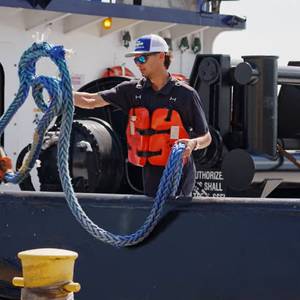
The American Waterways Operators, the trade association of the American tugboat, towboat and barge industry, has released a new video on the industry's contributions to U.S. national and homeland security.The two-minute video, The Tugboat, Towboat and Barge Industry: Supplying America, Securing America, notes that while the mariners who transport cargo and facilitate commerce on America's rivers