

Nuclear power has already crossed oceans. The harder question is whether modern small modular reactors can be integrated, licensed and financed for merchant ships, and where they make sense first.In 2023 the International Maritime Organization (IMO) set a goal of net-zero greenhouse gas emissions from international shipping by around 2050.

Anglo-Eastern has detailed its role in developing and preparing CMB.TECH's Mineral Europa, the world's first ammonia-powered dry bulk carrier, which recently embarked on its maiden voyage.The 210,000 dwt Newcastlemax, built by CSSC Qingdao Beihai Shipbuilding, features a WinGD dual-fuel ammonia engine and a Sun Rui Ammonia Fuel Supply System.

McAllister Towing received the tug Mary McAllister from Washburn & Doughty Associates, Inc. in Maine. Mary McAllister is the sixth in a seven-tug series of American Bureau of Shipping-classed and certified 84-metric-ton bollard pull, low-emission tractor tugs. Mary McAllister is powered by CAT Tier IV engines producing 6,770 horsepower.

On the release of a new ABS report “Decision Point: Practical Pathways to 2035” John McDonald, ABS Chairman and CEO, explains: “The industry has entered a new phase. For many years, the discussion centered on identifying a future fuel winner. Today, the challenge is broader. Shipping companies are making investment decisions for assets that will operate into the 2040s

The quest to rebuild U.S. shipbuilding capability quickly is premised on partnering with existing shipbuilding powers outside of China, with several recent announcements today solidifying the connection between the two allies.Four separate partnerships were recently announced, three today

ABS, Polaris Shipping, HD Hyundai Heavy Industries (HHI) and autonomous navigation solutions provider AVIKUS have signed a four-party Concept Study Agreement for the implementation of a Conditional Unmanned Bridge.Under the agreement, the parties will jointly develop an autonomous navigation concept enabling unmanned bridge operation during deep-sea voyages, when defined conditions are met

Introduction. Looking back at history one could argue that it was French author Jules Verne in his book “20,000 Leagues Under the Sea”, published in 1869, who was speculating about a new power source much in the same out of the box thinking that H.G. Wells employed when he wrote about inter-planetary flight in “War of the World’s.

Many claim to have ‘saltwater in their veins,’ but all you have to do is walk into the corner office of John McDonald, the new Chairman and CEO of the American Bureau of Shipping (ABS), to see that him saying “I was born into maritime” is not hyperbole. The first thing that greets you is a Dusan Kadlec nighttime painting of the Brooklyn Bridge

A new research project at the National University of Singapore (NUS) aims to accelerate the decarbonization of the global shipping industry through the development of next-generation ammonia-fueled marine engines with high efficiency and near-zero emissions.The project focuses on a novel in-cylinder reforming gas recirculation (IRGR) engine concept designed to address key limitations that have

As global demand for data storage and processing accelerates — driven by cloud computing, streaming media, and the explosive growth of artificial intelligence — the physical footprint of data centers has become a growing challenge. Land-based facilities face mounting constraints: limited space, water scarcity, grid congestion, long permitting timelines and rising community opposition.
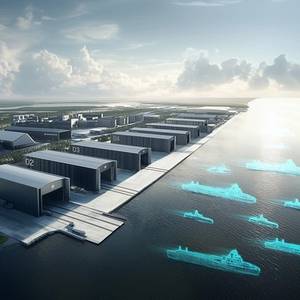
In a shipbuilding industry defined by tradition, one new entrant is seeking to rewrite the rules of how naval vessels are designed, built and delivered. Saronic Technologies, founded just three years ago, is racing to create what CEO Dino Mavrookas calls “a next-generation shipbuilding ecosystem” — one capable of delivering unmanned surface vessels (USVs) at the speed and scale the U.S.

“Shipping has entered a period where complexity is building faster than it can be absorbed," said ABS Chairman and CEO John McDonald at the annual gathering of the ABS Hellenic National Committee. "Costs are rising and decision cycles are shortening. This combination is creating a widening gap between what is technically possible and what is operationally viable at sea.