

The American Great Lakes Ports Association has signed a Memorandum of Understanding (MoU) with the Great Lakes Alliance of Shipyards to advance shared priorities in domestic shipbuilding and commerce.The MoU marks the first formal partnership between the U.S. Great Lakes port and shipyard communities.

If the Navy can’t successfully introduce smaller ship classes of ships, why does it think it can succeed with the largest surface combatants since World War II?The Navy has announced a new class of guided missile battleships, the USS Defiant [BBG(X)] or the Trump-class, as the centerpiece of a new “Golden Fleet.

The United States has become the world's largest oil exporter, upending a decades-old order long dominated by Saudi Arabia and Russia, a shift that tightens American companies' grip on energy markets as Washington's war with Iran reshapes global energy trade.America's ascendancy to the top spot marks a stunning reversal for a country that was dependent on Middle Eastern oil for decades and

The U.S. Supreme Court is set to explore legal questions arising from the fraught history of U.S.-Cuban relations when it considers the scope of a 1996 law that lets U.S. nationals seek compensation for property confiscated by the communist-led Cuban government.The justices hear arguments on Monday in two cases centered on the federal law called the Helms-Burton Act, one involving U.S.

With a growing focus on mitigating climate change and progressing toward the International Maritime Organization’s (IMO) 2050 net-zero target, the marine sector is under intense pressure to decarbonize. Today, maritime transport emits nearly one billion tons of CO2 annually, representing roughly 2-3% of all energy-related carbon emissions worldwide .

Explora Journeys celebrated the delivery of Explora III at Fincantieri's Sestri Ponente shipyard in Genoa. The vessel is the third ship built by Fincantier for Explora Journeys, MSC Group's luxury ocean travel brand.Held in the presence of national, regional and local authorities, the ceremony marked a milestone in the development of the Explora Journeys fleet

Seaspan Shipyards welcomed the Government of Canada’s announcement of ThyssenKrupp Marine Systems (TKMS) as the strategic build partner for the Canadian Patrol Submarine Project (CPSP). The project aligns with Canada’s Defence Industrial Strategy (DIS) and falls under the Build-Partner-Buy framework.

Victoria International Container Terminal (VICT), International Container Terminal Services, Inc.’s (ICTSI) fully automated operations at the Port of Melbourne, Australia, has deployed four new Kalmar hybrid automatic container carriers (ACC) following their successful commissioning and operational integration over the past several weeks.

GTT announced the signing of a Joint Development Project (JDP) with the shipyard HD Hyundai Heavy Industries focused on a 102,000 m³ Very Large Ethane Carrier (VLEC) featuring GTT’s Mark III Slim membrane containment system. This new project paces the way towards an optimized membrane-tank integration to enhance hull design and vessel’s overall performance.

HII’s Ingalls Shipbuilding division has delivered Arleigh Burke-class guided missile destroyer Ted Stevens (DDG 128) to the U.S. Navy. This marks the second Flight III Arleigh Burke-class destroyer to be delivered by Ingalls shipbuilders.“The delivery of Ted Stevens reflects the strong momentum of our destroyer program as we accelerate Flight III production and bring enhanced capabilities to the

Norwegian offshore vessel owner Solstad Maritime has sold its Normand Clipper construction support vessel (CSV) to Global Maritime Group.Global Maritime Group, the current charterer of the vessel, declared the purchase option for the Normand Clipper, with the deliver of set to take lace at the end of the firm contract period on June 1, 2026.
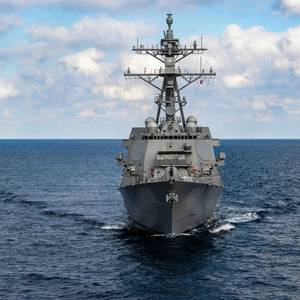
HII’s Ingalls Shipbuilding division successfully completed the final round of sea trials for Arleigh Burke-class guided missile destroyer Ted Stevens (DDG 128). The Ingalls Test and Trials team spent several days in port and at sea conducting a comprehensive series of acceptance test and evaluations, overseen by the Navy’s Board of Inspection and Survey (INSURV).