

The United States and French energy major TotalEnergies said on Monday they would redirect nearly $1 billion from offshore wind leases to U.S. oil and natural gas production.The agreement marks a new strategy in the Trump administration's wide-ranging effort to stymie development of U.S. offshore wind projects, which President Donald Trump has said he finds ugly, costly and inefficient.
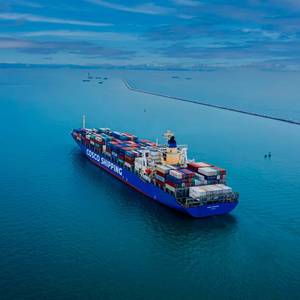
China's trade surplus topped $1 trillion for the first time as manufacturers seeking to avoid President Donald Trump's tariffs shipped more to non-U.S. markets in November, with exports to Europe, Australia and Southeast Asia surging.Shipments to the United States dropped by close to one-third from the same month a year before."The tariff cuts agreed under the U.S.

By Captain Bobbie Scolley, U.S. Navy (ret.) and Rear Admiral Tim Gallaudet, U.S. Navy (ret.)For more than six decades, spanning from 1905 to the late 1970s, the U.S. Navy’s diving apparatus for deep ocean operations and salvage remained fundamentally unchanged. During this period, the demographic of navy divers also saw little alteration.

Several top energy executives were dropped from the schedule of the WPC Energy Congress in Riyadh, as Saudi authorities pressed ahead with the event despite deadly attacks on the capital claimed by Yemen's Iran-aligned Houthis.The chief executives of ExxonMobil, TotalEnergies, Shell, Chevron and BP had all been expected at the event, which began on Sunday

Shipping bottlenecks, deep cuts in refinery output and inventory draws that could take years to replace will keep global oil prices high beyond this year, industry executives said at a conference in London on Monday.Following the start of the US-Israeli war on Iran at the end of February, Iran effectively closed the Strait of Hormuz

Oil extended gains by around 2% on Wednesday as President Donald Trump reimposed a naval blockade on all Iranian ports and Iran's Islamic Revolutionary Guard Corps threatened to close "all other export corridors that benefit the U.S. and its allies".Brent futures LCOc1 climbed $1.71, or 2%, to $86.44 a barrel at 0806 GMT. West Texas Intermediate futures CLc1 gained $1.43, or 1.8%, to $80.

Global liquefied natural gas demand is expected to rise by around 65% by 2050, driven largely by Asia as countries seek lower-emission alternatives to coal and data centres boost power demand, Shell said in an annual report on Tuesday.Global demand is likely to reach nearly 700 million metric tons a year by that date

Oil prices edged higher on Thursday, as investors monitored peace talks between the United States and Iran, while supply tightness and U.S. inventory drawdowns provided some support.Brent crude futures LCOc1 rose 40 cents, or 0.4%, to $105.42 a barrel by 0809 GMT, and U.S. West Texas Intermediate futures CLc1 were up 50 cents, or 0.5%, at $98.76.Both benchmarks dropped around 5.

Lloyd’s Register (LR) has tested Orca AI's AI-powered navigation system during a live vessel trial.The assessment focused on how AI-based computer vision can support human decision-making in real operating conditions, particularly in complex navigation scenarios such as congested waters and reduced visibility.

Oil prices jumped more than 6% in early Monday trading on fears that the ceasefire between the United States and Iran could collapse after the U.S. seized an Iranian cargo ship and traffic through the Strait of Hormuz remained largely halted.Brent crude futures LCOc1 advanced $5.51, or 6.1%, to $95.89 a barrel by 0752 GMT and U.S. West Texas Intermediate CLc1 was up $5.46, or 6.5%, at $89.31.

Kuwait Petroleum Corporation began cutting oil output on Saturday and declared force majeure, adding to earlier oil and gas reductions from Iraq and Qatar as the U.S.-Iran war blocked shipments from the Middle East for the eighth consecutive day.The war has blocked the world's most important oil artery the Strait of Hormuz which is responsible for 20% of global oil and LNG supply.

Wallem Group, a leading global maritime partner, is celebrating the centenary of moving its headquarters to Hong Kong.The celebrations will be marked by a special event on November 12, 2025 in the presence of Guest of Honour Hong Kong Finance Secretary, commemorating 100 years since the relocation—22 years after Norwegian shipbroker and agent Haakon Wallem formed Wallem & Co. in 1903.