

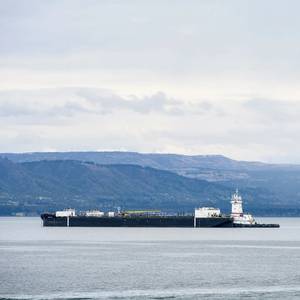
President Donald Trump has extended for 90 days a waiver allowing foreign-flagged ships to transport oil and other commodities between U.S. ports, but imposed new limits after shipbuilders and their allies in Congress argued the policy was undermining the domestic maritime industry, the White House said.

President Donald Trump’s waivers allowing foreign-flagged ships to move oil and fuel between U.S. ports have had little impact on high domestic gasoline prices due to elevated shipping rates and the relatively small fuel volumes transported so far, a Reuters analysis found.In March, Trump issued a waiver to the Jones Act, a century-old law that requires shippers to use vessels built

Today’s headlines bring constant news of international shipping hubs across the global supply chain experiencing major volatility and disruption – from Iran sending shockwaves through global energy markets by forcefully obstructing vessel traffic in the Strait of Hormuz; to the Iran-backed Houthis in Yemen signaling intent to restart attacks on shipping in the Red Sea; to China detaining

Wilson Sons operates in the port and shipping logistics industry throughout Brazil, boasting more than 188 years of experience. They offer solutions to over 5,000 clients, including shipowners, importers and exporters, the offshore energy industry, renewable energy projects, the agribusiness sector, as well as other players across various economic segments.

The United States Coast Guard (USCG) has rescued a family of three who had been missing for seven days in waters off the Federated States of Micronesia.The crew of the USCGC Midgett located the family on April 6 after authorities reported the vessel overdue following its departure from Fananu Island on March 30.

HII announced the selection of two vice presidents at its Newport News Shipbuilding (NNS) division. Christie Miller has been promoted to the role of vice president of communications and Christian Ortego will join the division as vice president and NNS chief counsel.In her new role, Miller will have responsibility for internal and executive communications, special events and protocol

China is conducting a vast undersea mapping and monitoring operation across the Pacific, Indian and Arctic oceans, building detailed knowledge of marine conditions that naval experts say would be crucial for waging submarine warfare against the United States and its allies.In one example, the Dong Fang Hong 3, a research vessel operated by Ocean University of China

Wilson Sons held a launch ceremony for the tugboat WS Halcyon Thursday, January 29, in Rio de Janeiro. It is the first of a new series of three high-powered tugs.Built at the company’s shipyard in Guarujá (São Paulo), WS Halcyon is a class 2312 tug (23 meters long and 12 meters wide) with azimuth propulsion and 70 tons of bollard pull

The U.N. Security Council on Wednesday asked U.N. Secretary-General Antonio Guterres to continue providing monthly reports on any further attacks on vessels in the Red Sea by Yemen's Houthis, spurring Russia to taunt the United States."We believe that amid present-day realities, the Security Council would be well advised to monitor attacks on commercial transport in the Caribbean, not the Red Sea
It’s been said that American maritime is “having a moment” in Washington, DC.From President Trump’s Executive Order on Restoring America’s Maritime Dominance, to introduction of the bipartisan, bicameral SHIPS for America Act in Congress, the U.S. maritime industry has been a subject of focused attention at the highest levels of government, and rightfully so.

Wilson Sons, a port and shipping logistics operator with over 188 years of experience, launched WS Ariel on August 20 at Pier Mauá (Rio de Janeiro). WS Ariel is the third high-powered tugboat in the company's new shipbuilding series.Like WS Halcyon and WS Capella, launched in January and May this year, respectively, WS Ariel was built at Wilson Sons’ shipyard in Guarujá (São Paulo).
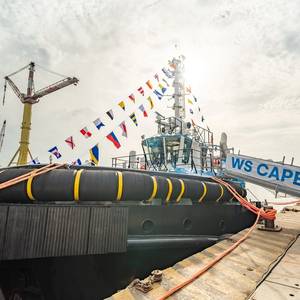
Wilson Sons, a port and shipping logistics operator with over 188 years of experience, has held the launch ceremony of WS Capella, the second tug of a new range of three high-powered tugboats.Just like WS Halcyon, baptised in January this year, WS Capella was built at the company's shipyard and is also an ASD 2312 class tug (23 meters long, 12 meters wide).