

A container ship will depart from South Korea bound for Europe via the Arctic on Saturday, testing whether a route opened by melting sea ice can be commercially viable, but risking friction with Western allies, as the voyage requires Russian cooperation.If successful, the trip would be South Korea's first such commercial voyage to Europe via the Arctic

On July 23rd, 2026 Amtech, courtesy an invitation from the U.S. Department of Commerce, attended the Grand Opening of the Korea-U.S. Shipbuilding Partnership Center (KUSPC) in Washington DC, a Secretary level event with invitations provided to recognized leaders in the U.S. commercial and naval shipbuilding industry.

Australian mining company Fortescue has signed an agreement with Belgian shipping and cleantech group CMB.TECH to charter up to 12 ammonia-capable bulk carriers, stepping up efforts to decarbonize maritime transport and support the development of green ammonia as a marine fuel.Under the agreement, Fortescue will charter 12 Newcastlemax dry bulk vessels, each with a carrying capacity of 210

Saudi Arabia and neighbouring Gulf producers will cheer the eventual reopening of the Strait of Hormuz, but the ensuing flood of oil risks eroding OPEC’s already fragile grip on the market.The Iran war and the closure of the vital waterway – through which nearly a fifth of the world’s oil and gas flowed before the conflict – have sharply diminished output from the Organization of the Petroleum

Shippers on Wednesday said they needed more clarity on the terms of the U.S.-Iran ceasefire before resuming transit through the Strait of Hormuz, as Iran said the waterway remained closed to vessels sailing without a permit.The six‑week conflict had brought traffic through the strait - a chokepoint for about 20% of global oil and liquefied natural gas (LNG) shipments - close to a standstill

U.S. President Donald Trump's move allowing foreign-flagged cargo ships to move fuel and other goods between domestic ports has so far had little impact on American oil supply, according to trade data and analysts who noted that U.S. refiners and shippers are earning more profits sending fuel overseas.

At first glance, the Iran war appears to be hitting oil and gas with equal force, as missiles, drone strikes and shipping disruptions choke flows through the Strait of Hormuz.But beneath that surface symmetry lies a critical imbalance. The global gas supply chain has fewer rerouting options and less storage capacity than the oil market - making the fallout for gas consumers considerably more

The U.S. Supreme Court is set to explore legal questions arising from the fraught history of U.S.-Cuban relations when it considers the scope of a 1996 law that lets U.S. nationals seek compensation for property confiscated by the communist-led Cuban government.The justices hear arguments on Monday in two cases centered on the federal law called the Helms-Burton Act, one involving U.S.

The Trump administration suspended leases on Monday for five large offshore wind projects that are under construction off the U.S. East Coast over what it called national security concerns, sending shares of offshore wind companies plunging.The suspension was the latest blow for offshore wind developers that have faced repeated disruptions to their multi-billion-dollar projects under U.S.

The U.S. inland waterways don’t just move cargo — they move people into long-term, well-paid careers. At a time when trucking and rail struggle with shortages, turnover, and burnout, inland waterways operators quietly offer something different: a job you can start without experience, a career you can grow into, and a paycheck that gets better every step of the way.
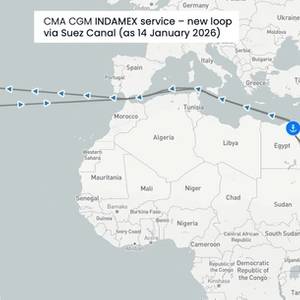
Major carrier CMA CGM has announced its INDAMEX service will transit Suez Canal on fronthaul and backhaul voyages between India/Pakistan and US East Coast in a notable step towards a largescale return of container ships to the Red Sea region.The first vessel to complete a full service loop via Suez Canal will be CMA CGM Verdi, sailing from Karachi to New York on 15 January.
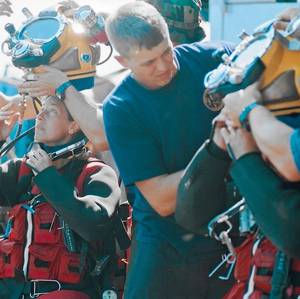
By Captain Bobbie Scolley, U.S. Navy (ret.) and Rear Admiral Tim Gallaudet, U.S. Navy (ret.)For more than six decades, spanning from 1905 to the late 1970s, the U.S. Navy’s diving apparatus for deep ocean operations and salvage remained fundamentally unchanged. During this period, the demographic of navy divers also saw little alteration.