

Nuclear power has already crossed oceans. The harder question is whether modern small modular reactors can be integrated, licensed and financed for merchant ships, and where they make sense first.In 2023 the International Maritime Organization (IMO) set a goal of net-zero greenhouse gas emissions from international shipping by around 2050.

When artificial intelligence (AI) and digitalization are discussed in maritime, attention still gravitates toward autonomous ships. Yet the market is not about de-crewing but, rather, applying vessel and shore data to make operations safer, more fuel-efficient, and easier to maintain.As of 2024, the maritime AI market stood at $4.13 billion, with a projected five-year CAGR of 23%.

A Japanese consortium led by shipping giant NYK Line has developed a new port-based floating data center concept designed to accelerate the commercialization of offshore data centers while addressing growing constraints on land availability, electrical power and construction timelines.

The U.S. Navy’s Military Sealift Command is a critical part of the United States’ national security equation, as any navy only goes as far as its supply chain allows. RADM Benjamin Nicholson, Commander, U.S. Navy Military Sealift Command, visited with Maritime Matters: The MarineLink Podcast, for a deep discussion on MSC

Technology companies and shipyards are vying for attention as the US unmanned navy grows in size and sophistication.No too long ago, US Navy Secretary John Phelan said: “If the last few years of conflict have taught us anything, it is that we will not win the wars of the future with the platforms of the past.

For decades, floating nuclear power occupied a niche position in the energy debate – technically feasible, strategically intriguing, but commercially marginal. Today, however, combined pressures of decarbonization, energy security, land constraints, rising electricity demand and water scarcity are making floating nuclear power a more serious proposition for policymakers, utilities

A dual fuel combustion system developed by Oak Ridge National Laboratory (ORNL) in collaboration with Caterpillar Inc. addresses the challenge of methanol ignition in diesel engines, with clear relevance for inland and coastal marine vessels.Methanol is typically produced from natural gas, an abundant domestic resource, and converting it into a liquid allows easier storage and handling.

The IMO's Maritime Safety Committee met for its 111th session from May 13 to 22 and adopted a global code for autonomous ships and advanced guidelines for ships operating on alternative fuels.First global code for autonomous shipsIMO adopted a new International Code of Safety for Maritime Autonomous Surface Ships (MASS Code) to support the safe integration of AI-enabled and remotely operated

Security is all too often treated as a purely compliance-driven exercise. This isn’t advisable in any industry, but it is particularly damaging for those that fall under critical infrastructure frameworks. Ports, and, by extension, the dredging operations that maintain and expand shipping lanes, are the backbone of global trade, underpinning essential supply lines.

Malaysia's Prime Minister Anwar Ibrahim said on Thursday he had spoken to the leaders of Iran, Egypt, Turkey and other regional countries and said Malaysian vessels were now being allowed to pass through the Strait of Hormuz.Anwar in a televised address thanked Iran's president for allowing the passage of Malaysian ships.

U.S. President Donald Trump on Saturday said India will buy Venezuelan oil, helping to replace some of the Russian oil that the world's third-biggest oil importer buys. "We've already made that deal, the concept of the deal," Trump told reporters aboard Air Force One as he traveled to his vacation home in Florida from Washington.
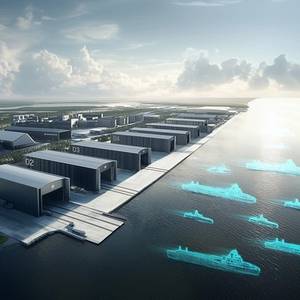
In a shipbuilding industry defined by tradition, one new entrant is seeking to rewrite the rules of how naval vessels are designed, built and delivered. Saronic Technologies, founded just three years ago, is racing to create what CEO Dino Mavrookas calls “a next-generation shipbuilding ecosystem” — one capable of delivering unmanned surface vessels (USVs) at the speed and scale the U.S.