

Roll-on/Roll-off (RoRo) shipping and vehicle logistics group Wallenius Wilhelmsen has taken delivery of Arctic Tern, the first dual-fuel methanol-ready vessel in its new Shaper Class series.Arctic Tern vessel offers greater cargo capacity and improved operational efficiency and will be deployed through EUKOR Car Carriers

A record wave of global investment in new ships is translating into sustained growth for Germany's marine equipment industry, with suppliers reporting rising revenues, strong order books and growing optimism despite mounting geopolitical and competitive pressures.According to the latest industry survey from VDMA, Germany's maritime supplier sector posted average revenue growth of 5.

The world's oil tanker fleet is behaving as if the Strait of Hormuz is reopening — even as the waterway itself remains only partially navigable and politically contested. From ship tracking data to freight rates, the signals are clear: owners and charterers are moving early to position vessels for a return to Gulf exports.

The United States, Britain and Australia are working together to develop unmanned undersea vehicles as part of their trilateral AUKUS defence pact, U.S. Secretary of Defense Pete Hegseth told reporters on Saturday.AUKUS said in a joint statement that delivery of the vehicles will start in 2027.

Diamond Gas Jade, a 174,000-cu.-m. Liquefied Natural Gas (LNG) carrier invested by a joint venture under U-Ming Marine Transport Corp., held its grand naming ceremony on May 19 at the Samsung Heavy Industries Geoje Shipyard. Built by Samsung Heavy Industries, Diamond Gas Jade is equipped with the latest energy-saving environmental technologies and a dual-fuel propulsion engine.

Pakistan's Navy will be getting a fleet of advanced Chinese submarines, a statement from the military and a government official said on Thursday, a move to strengthen Islamabad's maritime security as part of a growing defence cooperation with Beijing.The subs are in addition to Chinese-made J10-C fighter jets, which were war-tested for the first time during last year's Pakistan-India conflict.

An LNG tanker managed by UAE's ADNOC has crossed the Strait of Hormuz and appears to be near India, ship-tracking data showed on Monday.If confirmed, this will be the first loaded LNG tanker to cross the strait since the Iran war started on February 28. Adnoc did not immediately respond to a Reuters request for comment.

Continuous design refinement and incremental productivity gains — reflecting the Japanese concept of kaizen — alongside unremitting attention to contractual performance and product quality have seen the country’s shipbuilders maintain a high profile in certain sectors of the commercial vessel market.

Many claim to have ‘saltwater in their veins,’ but all you have to do is walk into the corner office of John McDonald, the new Chairman and CEO of the American Bureau of Shipping (ABS), to see that him saying “I was born into maritime” is not hyperbole. The first thing that greets you is a Dusan Kadlec nighttime painting of the Brooklyn Bridge

A.P. Moller - Maersk has ordered eight large container vessels from China’s New Times Shipbuilding.All eight ships will have the same characteristics and make up a new series of 18,600 TEU vessels with delivery in 2029 and 2030.The ships will be equipped with dual-fuel engines able to operate on conventional bunker fuel or liquified gas.
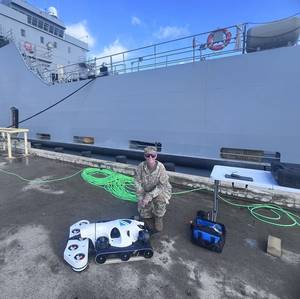
Sticking to legacy tactics won't beat China — adopt Secretary Hegseth's and the Army initiatives or surrender the edge.In a recent address, Admiral Christopher Grady, Vice Chairman of the Joint Chiefs of Staff, underscored the urgent need for a robotic hull-cleaning system to enable anytime maintenance, reduce drag, boost speed, and minimize fuel consumption for naval vessels.
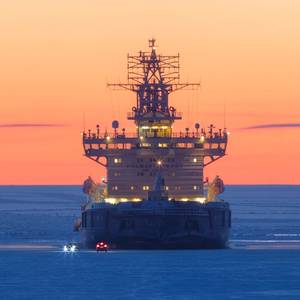
The Arctic is no longer a remote expanse beyond the edges of global commerce — it is now a contested arena where strategic competition, energy development, and maritime innovation converge. As climate change accelerates sea ice retreat, previously impassable waters are opening to navigation for longer periods each year.