

The United States is having a maritime moment. Maritime is back on the national agenda. The Maritime Action Plan, the SHIPS for America Act,and now the Administration’s August 13 memorandum on rebuilding the Navy and America’s shipbuilding industrial base have renewed the conversation about rebuilding America's maritime capability.

The American Great Lakes Ports Association has signed a Memorandum of Understanding (MoU) with the Great Lakes Alliance of Shipyards to advance shared priorities in domestic shipbuilding and commerce.The MoU marks the first formal partnership between the U.S. Great Lakes port and shipyard communities.

The U.S. Department of Transportation's Maritime Administration (MARAD) and CORE POWER (US) Inc. signed an agreement to accelerate the commercial, industrial, and regulatory pathways for U.S.-flagged nuclear-powered commercial ships. Fueled by small modular reactor (SMR) technology

President Donald Trump has extended for 90 days a waiver allowing foreign-flagged ships to transport oil and other commodities between U.S. ports, but imposed new limits after shipbuilders and their allies in Congress argued the policy was undermining the domestic maritime industry, the White House said.

CHICAGO — July 30, 2026 — The United States cannot rebuild its maritime strength by focusing solely on its ocean coasts. Instead, the nation's industrial resurgence depends on recognizing the Great Lakes as one of America's five maritime coastlines and leveraging the region's unmatched manufacturing ecosystem, according to U.S. Maritime Administrator Stephen M. Carmel.

Two supertankers and one liquefied natural gas (LNG) tanker exited the Strait of Hormuz earlier this week with their transponders switched off, and are heading for India and China, shipping data from LSEG and Kpler showed.The vessels joined a number of tankers leaving the Gulf this month, although oil and LNG traffic overall has still been limited.

A joint letter organized by the American Biofuels Maritime Initiative (ABMI) has been sent to U.S. Secretary of State Marco Rubio ahead of this week's negotiations at the IMO MEPC 84 meeting in London. The effort is aimed at ensuring that global maritime decarbonization also translates into durable new demand for American biofuels and additional income streams for U.S.

The White House is expected to extend the Jones Act waiver for up to 90 days as early as Friday to help blunt fuel price pressures tied to the Iran conflict, according to two sources familiar with the decision.The move would temporarily ease requirements that goods transported between U.S.

The United States and French energy major TotalEnergies said on Monday they would redirect nearly $1 billion from offshore wind leases to U.S. oil and natural gas production.The agreement marks a new strategy in the Trump administration's wide-ranging effort to stymie development of U.S. offshore wind projects, which President Donald Trump has said he finds ugly, costly and inefficient.

Major US maritime organizations have issued statements voicing their concern over the Trump Administration’s decision to issue a sweeping 60-day waiver of the Jones Act.Under the Jones Act, goods shipped between U.S. ports must be carried on vessels that are U.S.-built, U.S.-flagged and mostly U.S.-owned. A coalition of U.S.
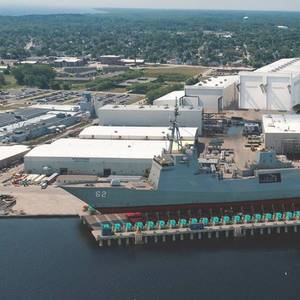
Fincantieri and the U.S. Navy have reached an agreement to redefine the future of the Constellation-class frigate program, ensuring work continues on the first two ships while cancelling four later units as part of a wider fleet review.The shift follows the Navy’s overhaul of its force-structure plans and aligns with new priorities aimed at accelerating next-generation ship designs and

HD Korea Shipbuilding & Offshore Engineering (HD KSOE) has secured a contract to build two liquefied natural gas (LNG) carriers for a North American shipowner.The order is valued at 741.2 billion won (about $507 million), HD KSOE said.The vessels will be constructed by HD Hyundai Samho and are scheduled for delivery in 2028.