

ADNOC Logistics & Services (ADNOC L&S) has agreed to acquire 11 tankers for approximately $1.3 billion, expanding its crude oil and liquefied petroleum gas (LPG) shipping capacity to support ADNOC Group's growing production, trading and export activities.The acquisition comprises five very large gas carriers (VLGCs) and six very large crude carriers (VLCCs).

ADNOC Logistics and Services (ADNOC L&S) has ordered four new liquefied natural gas (LNG) carriers from China’s Jiangnan Shipyard for about $900 million, expanding its LNG newbuild program to 18 vessels, while also taking delivery of the first of four very large ammonia carrier (VLAC) newbuilds.The four ships will each have a capacity of 175,000 cubic meters and are scheduled for delivery in 2029.

Oman's Asyad Group and France's CMA CGM Group have signed a framework agreement to develop, manage and operate a multipurpose logistics terminal in Sohar, establishing a strategic partnership aimed at boosting maritime connectivity and opening new regional trade corridors.The agreement, signed during the official visit of Sultan Haitham bin Tarik to France

Brazil's state-controlled oil company Petrobras has signed a $427 million contract through its logistics subsidiary Petrobras Transporte (Transpetro) with the Rio Grande Shipyard for the construction of four medium range tankers as part of a broader program to renew and expand its shipping fleet.

CMA CGM delivered a resilient first quarter, but the numbers underscore the increasingly complex environment facing the global container shipping and logistics giant.The Marseille-based group reported first-quarter revenue of $13.23 billion, essentially flat year-over-year, while EBITDA fell 31.6% to $2.11 billion and net income dropped sharply to $250 million, down from $1.

CF Industries, Trafigura and TFG Marine have signed a memorandum of understanding (MoU) to facilitate the adoption of low-carbon ammonia as a marine fuel.Building on the successful collaboration between CF Industries and Trafigura in the shipment of low-carbon ammonia, the agreement establishes a framework for the parties to work together on advancing low-carbon ammonia as a marine fuel

Equinor said it is complying with a stop-work order issued by the U.S. Department of the Interior’s Bureau of Ocean Energy Management (BOEM), which ordered the suspension of offshore construction activities on the Empire Wind project citing national security concerns.Empire Offshore Wind LLC, the project company
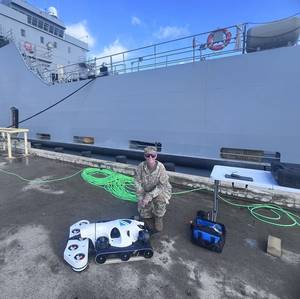
Sticking to legacy tactics won't beat China — adopt Secretary Hegseth's and the Army initiatives or surrender the edge.In a recent address, Admiral Christopher Grady, Vice Chairman of the Joint Chiefs of Staff, underscored the urgent need for a robotic hull-cleaning system to enable anytime maintenance, reduce drag, boost speed, and minimize fuel consumption for naval vessels.
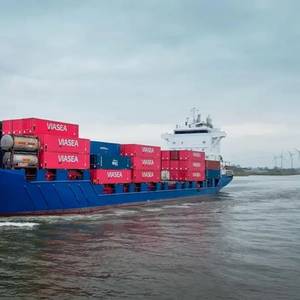
Ellerman City Liners, part of GB Global, has acquired Viasea Shipping from Norway’s ColliCare Holding AS, a move that strengthens Ellerman’s position in the European shortsea shipping market and deepens its commitment to sustainable logistics solutions.Founded in 2016, Viasea has grown rapidly as a challenger brand in Northern Europe’s shortsea sector, operating scheduled services between the UK
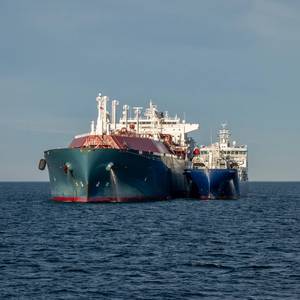
A sanctioned liquefied natural gas (LNG) tanker made a ship-to-ship (STS) transfer off the coast of Malaysia after picking up a cargo from a Russian export terminal also under Western restrictions, according to two analytics firms.The operation appears to be the first known STS transfer of sanctioned Russian LNG, despite Western efforts to curb Moscow's energy revenues over its war in Ukraine.
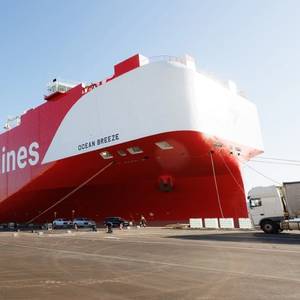
Sallaum Lines has launched its first LNG dual-fuel pure car and truck carrier (PCTC) newbuilding, the Ocean Breeze, with a landmark ceremony in the port of Antwerp.The Ocean Breeze has capacity for 7,500 CEU and is powered by dual-fuel LNG engines. The vessel delivers substantial reductions in CO2, NOx, and particulate emissions compared to conventional tonnage.
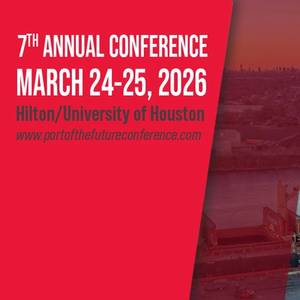
New Wave Media, a leading B2B media company serving the global maritime, offshore energy, subsea and logistics sectors, acquired the Port of the Future Conference & Exhibition, a premier international symposium known for its focus on advancing port infrastructure, technology, and policy.