

Dorian LPG took delivery of its 93,000 cubic meter (cbm) dual-fuel newbuilding named Areion an LPG and ammonia very large gas carrier (VLGC/AC) from Hanwha Ocean Heavy Industries Co., Ltd. at the Okpo Shipyard in South Korea. Areion will commence employment on charter under the Helios LPG Pool, an entity jointly controlled by Dorian LPG Ltd and MOL Energia Pte Ltd.

Greenland's Prime Minister Jens-Frederik Nielsen said on Sunday "no thanks" to U.S. President Donald Trump's idea of sending a hospital ship to Greenland, a territory that Trump has repeatedly said he wishes to take over.Trump said on Saturday on social media he was working with Louisiana Governor and special envoy to Greenland, Jeff Landry, to send a hospital boat to Greenland.

Seatrium delivered FREDERICK PAUP to Manson Construction Co. Built at Seatrium’s Brownsville Texas yard, the Jones Act-compliant vessel is the largest self-propelled hopper dredger in US history.Key highlights:Largest in the U.S. – 420’ length x 81’ beam, with a 15,000+ cubic yard hopper capacityPowerful and Agile – Self-propelled with 25,000 horsepower, triple azimuthing stern drives
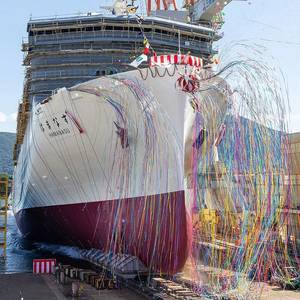
Second of Two Large Car Ferries Ordered by Shinnihonkai Ferry and Japan Railway Construction, Transport and Technology Agency Second ferries in Japan to use a buttock-flow stern hull and ducktail design, providing energy savings of 5% Delivery scheduled for June 2026, planned to go into service between Otaru and MaizuruMitsubishi Shipbuilding Co., Ltd.
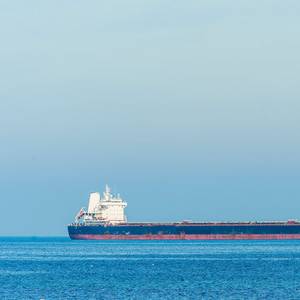
Terminal operators in a major oil port in east China's Shandong province are set to introduce measures to ban shadow fleet vessels and curb visits by other old tankers, according to an official notice seen by Reuters and a tanker tracker.The measures, to take effect from November 1, would ban vessels using fake IMO numbers and ships of 31 years or older
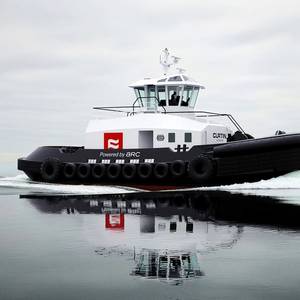
While political winds in the U.S. have significantly tampered many ‘green’ projects, Curtin Maritime is domiciled in California, which is globally known for its strict environmental initiatives. To that end, Curtin Maritime inked a contract recently to invest $160m for eight new hybrid-electric tugboats, vessels being built by Snow & Co.
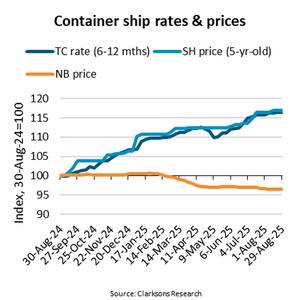
Despite significantly weaker freight rates, the average price for five-year-old container ships has increased 17% year-on-year and 6% since the beginning of 2025,” says Niels Rasmussen, Chief Shipping Analyst at BIMCO.The average per TEU price of a basket of seven five-year-old container ships was $9,761/TEU in late August 2024.
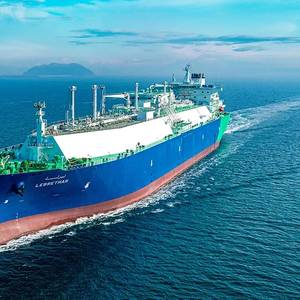
China’s share of the tanker orderbook rose from 32.4% in 2022, to 62.6% in 2023 and then 71.2% in 2024. Its share of the container ship orderbook has shown a similar growth trajectory. The nation has ranked first in the world for new orders since 2012. Labor costs are about half of what they are in Korea and Japan, and China is the world’s cheapest steel manufacturer.
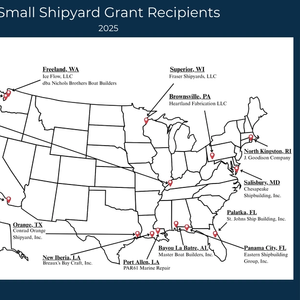
U.S. Transportation Secretary Sean P. Duffy has announced that the Maritime Administration (MARAD) has awarded $8.75 million in grants to revitalize U.S. shipyards and advance America’s maritime dominance.The funding is part of the Small Shipyard Grant program, which supports advanced training, workforce development and new technologies that strengthen U.S. shipbuilding and repair capabilities.
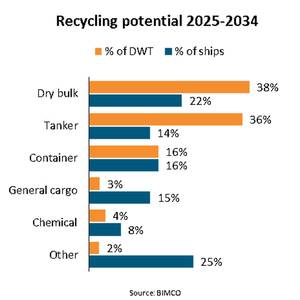
“As the Hong Kong International Convention for the Safe and Environmentally Sound Recycling of Ships (Hong Kong Convention) enters into force we have updated our estimate for the ship recycling potential over the next 10 years. We now estimate the potential to be 16,000 ships, or 700m deadweight tonnes (DWT), from previously 15,000.
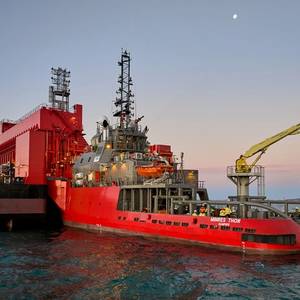
Australia’s unique enclosed self-discharging transhippers ensure a dust-free supply chain for the Onslow Iron project.Onslow in north Western Australia is a desert. It receives less than 10 inches of rain a year, and for much of the year temperatures reach 95 degrees Fahrenheit. It’s known for dust storms that can turn the town red.
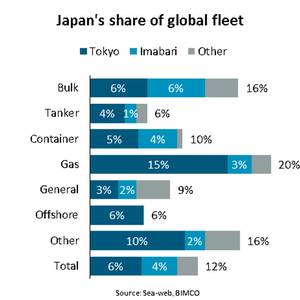
Japan is world’s third largest shipping nation as owners control 12% of the fleet“Combined, Japanese shipowners currently own 12% of the global fleet’s deadweight tonnes capacity (DWT). This makes Japan the third largest shipowning country in the world and one of only three countries where shipowners control more than 10% of the global fleet’s DWT capacity,” says Niels Rasmussen