

Rescuers were searching for seven missing crew on Thursday from one of two chemical tankers that caught fire overnight inside Romanian territorial waters in the Black Sea, after Russian drones strayed into Romanian airspace, Romanian officials said.Romanian officials stopped short of explicitly linking the fires onboard the ships to the Russian drones.

Eleven sailors were missing at sea on Tuesday from a ship sunk by a drone attack off the coast of Bulgaria, possibly the second deadly sinking of a cargo vessel in the area in a week, prompting Bulgaria to summon Russia's ambassador.Two cargo ships were hit by drones overnight and one was sunk, Bulgarian officials said.

Part of a group of companies that make up Fraser Industries, Fraser Shipyard is a 138-year-old on Lake Superior, an organization which makes equal revenue from newbuild and ship repair, able to work in both steel and aluminum. Recently it signed a collaboration agreement with HD Hyundai to help migrate process and technology from one of the world’s biggest and best shipyard to the shores of Lake

A joint letter organized by the American Biofuels Maritime Initiative (ABMI) has been sent to U.S. Secretary of State Marco Rubio ahead of this week's negotiations at the IMO MEPC 84 meeting in London. The effort is aimed at ensuring that global maritime decarbonization also translates into durable new demand for American biofuels and additional income streams for U.S.

Taiwan remained on high alert on Wednesday after China staged massive military drills around the island the previous day, keeping its emergency maritime response centre running as it monitored Chinese naval manoeuvres, the coast guard said.The exercises named "Justice Mission 2025" saw China fire dozens of rockets towards Taiwan and deploy a large number of warships and aircraft near the island

The U.S. inland waterways don’t just move cargo — they move people into long-term, well-paid careers. At a time when trucking and rail struggle with shortages, turnover, and burnout, inland waterways operators quietly offer something different: a job you can start without experience, a career you can grow into, and a paycheck that gets better every step of the way.
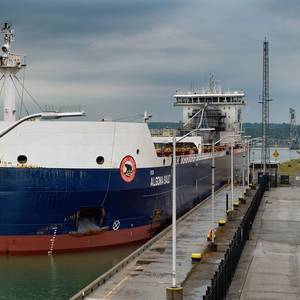
St. Catharines, Ontario–based Algoma Central Corporation (TSX: ALC) reported a solid third quarter for 2025, marked by fleet milestones, steady revenue growth across segments, and ongoing investment in next-generation vessels.For the quarter ended September 30, Algoma posted revenue of C$228 million, up from C$205 million a year earlier, and EBITDA of C$89.7 million, a 19% increase year-over-year.

Up to 70 vessels are waiting near the Danube's Sulina Canal for access to Ukrainian ports to load grain for export, traders and analysts said on Wednesday, with a shortage of pilots and priority given to other cargoes creating long delays.After Russian attacks effectively blocked Ukraine's Black Sea ports, which had handled 90% of the country's grain exports

Russia's main grain lobby group warned on Friday that Ukrainian drone attacks on Russian ships and ports could shut down grain exports via the Black Sea in the near future, pushing up prices and causing hunger in Africa and the Middle East.Russia, the world's largest wheat exporter, and Ukraine, also a major agricultural exporter

“Global grain shipments have increased 13% y/y so far this year, supported by strong wheat, maize and soya bean exports from the Americas and Europe. Improved harvests across most major exporters have boosted their export surpluses, driving higher shipments to Asia, the Middle East and North Africa,” says Filipe Gouveia, Shipping Analysis Manager at BIMCO.

A vessel carrying grain that Ukraine says was stolen from areas occupied by Russia will not unload in Israel, Ukraine said on Thursday, after Kyiv requested Israel to seize the cargo.Ukraine's prosecutor general, Ruslan Kravchenko, said on the Telegram app that the vessel, Panormitis

Ukraine has asked Israel to seize a vessel carrying grain it says was stolen from areas occupied by Russia, its top prosecutor said on Wednesday, amid a diplomatic tussle between the two countries over the shipment.Ukraine and Israel traded accusations on Tuesday, with Ukraine saying it had repeatedly urged Israel via diplomatic channels to take measures regarding the vessel.